SBC execution
op_infer.sbc.run_sbc schedules a fixed bank of calibration replicates. Install
op_infer[study]; fitting remains the caller's reporting estimator. The runner
uses trade_study.run_grid for scheduling and the existing op_infer.calibrate
rank-file schema for aggregation. It introduces no sampler or executor.
For leave-one-unit-out calibration, use the masked-unit runner,
which retains complete planned IDs, stratum counts and baseline comparisons.
Supply a prior sampler, simulator and estimator accepting RandomKey addresses,
a mapping of SBCEstimand records, real observations and their optional mask,
complete Provenance, a root seed, and explicit prespecified replicate IDs.
Each estimand transforms either parameter scalars or posterior variable arrays
into a scalar truth or one value per draw. Its prior SD must use the same scale;
declare atoms=True for point masses or discrete quantities. The estimator
returns SBCFit(draws, diagnostics) with scalar variables on one draw dimension.
Parameter, simulation, reporting-estimator and per-estimand rank streams are
separate. IDs do not depend on grid position, shard size or worker order. Split a
planned bank into disjoint ID sets and use the same seed, provenance and directory
for every shard. n_jobs delegates local parallel execution to trade-study; the study extra
installs its native parallel dependency.
The simulator must implement the same prior, observation support and acceptance rule used for training/fitting. The runner applies no extra plausibility filter. It checks simulated data against the real observations before fitting or ranking. Simulation errors, non-finite draws, estimator failures and inadequate MCMC fits become failed records and stay in the denominator. Catchable timeouts can be reported as failures; a worker killed before writing a record remains an unfinished task, not a successful replicate.
MCMC fits require kind="mcmc", an explicit adequate=True verdict and finite
effective_sample_size >= 2. The runner retains supplied diagnostics and uses
evenly spaced draws up to floor(ESS). This policy does not compute adequacy or
prove those draws independent; the estimator adapter owns that qualification.
Independent NPE draws use kind="independent" and do not fabricate MCMC statistics.
An atomic sbc-manifest.meta contains the complete provenance and settings; each
rep_*.json references its identity and stable replicate ID in _meta. The
caller must identify callback/model/estimator revisions in provenance. Existing
files are reused only under the same contract, including seed, observation bytes,
mask, estimand names, atom rules and prior SDs. Failed records remain failed on
resume. Use a new directory for a scientific revision or a deliberate rerun.
Concurrent duplicate IDs fail through explicit lock files; remove a stale lock
only after verifying that its worker has stopped.
After all planned shards finish, call load_replicates, aggregate and gate.
Write the aggregate ledger outside the replicate directory, whose *.json files
are all interpreted as replicate records. SBCExecution reports requested,
written, resumed and failed counts; it is not a calibration verdict. Preselect
replicate counts using the trade-study proportion/precision helpers and retain
the aggregation power floor and multiplicity rules. A small unflagged bank does
not establish calibration. Use coverage_summary for marginal Wilson coverage summaries,
coverage planning for a fixed coverage family and optional
reference TARP curves, and saved gate records for prespecified scalar
criteria and amendments.
Illustrated analytic fixture
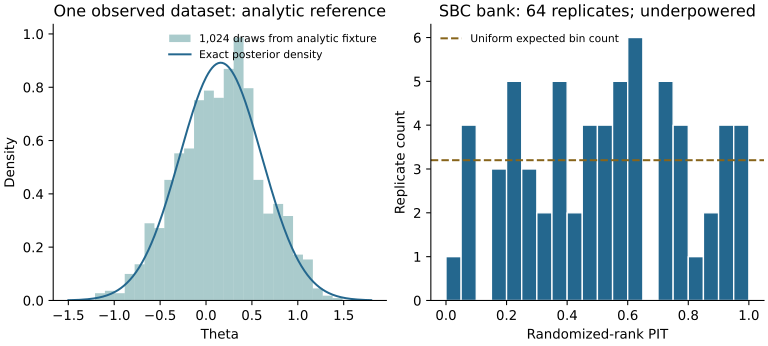
The runnable examples/normal_sbc.py uses a normal prior and four independent
unit-variance observations, with an exact normal posterior. Its illustrative
bank contains 64 replicates and is deliberately underpowered.
| Quantity | Value |
|---|---|
| Requested replicates | 64 |
| Failed replicates | 0 |
| Resumed replicates | 64 |
| Total in ledger | 64 |
| Underpowered | True |
| Gate label | underpowered pass |
| Exact posterior mean (observed data) | 0.1600 |
| Exact posterior SD | 0.4472 |
For the observed data [0.2, -0.1, 0.3, 0.4], the posterior mean is
sum(y) / 5 = 0.16 and its variance is 1 / 5. The left panel compares draws
from the analytic fixture with that independent mathematical reference. The
right panel displays the actual bank's rank PITs; the dashed line is the
uniform expected bin count. A small bank's apparent histogram shape and
underpowered pass label cannot establish calibration or adequate gate power.
The exact posterior is a fixture, rather than an implemented sampler.
Download the vector PDF. From a checkout:
uv run --extra study --with matplotlib==3.11.2 python examples/illustrate_normal_sbc.py
just figures-check
Generation uses a fresh temporary bank, checks guarded resume, and retains the full plotted inputs. The check reruns the same fixture and verifies the table, plotted data and source/export fingerprints without Matplotlib. It requires the study extra and runs in the required study CI job.
Robustness under a perturbed generator
SBC under the training generator checks the computation, not the behaviour of an unchanged estimator when the data come from another generator. Neural simulation-based inference can degrade under misspecification and no tested remedy works in all cases (Cannon, Ward and Schmon 2022, arXiv:2209.01845; Ward et al. 2022, arXiv:2210.06564).
Run the same planned bank twice with the same seed, replicate IDs, estimator and
estimands: once as the control, once with callbacks that implement a declared
perturbation, passing stress=StressSpec(name, description, settings) to
run_sbc. The stress record enters the immutable run contract, so the two banks
cannot share a directory. Then call op_infer.stress.stress_verdict(stress_dir,
control_dir, estimands, level=..., floor=..., drop=...). It reads the two run manifests and raises
ValueError unless the stress bank carries a stress record and the two contracts
otherwise agree.
The helper pairs replicates by replicate ID, counts failed and unpaired
replicates instead of dropping them, reports the coverage of the central interval
under stress and control with Wilson intervals, and passes an estimand when its
stress coverage point estimate is at least max(floor, control coverage - drop)
(the Wilson intervals are reported but do not enter the decision). floor and
drop have no defaults: they are the caller's reading-rule choices, to be fixed
before the banks are read. The result is a robustness reading, not
calibration; the intervals are marginal and carry no adjustment across
estimands. When the perturbation changes the prior sampler, the paired truths
differ by construction; the runner does not store the truths, so the helper
cannot count equal-truth pairs.