Reporting-triangle nowcaster
Configured baselinenowcast point comparison · 2026-10-01
Audit qualification: this is a 52-week, signed-revision configuration, not the high-level package defaults. Continuous signals use a unit-preserving adaptation. A corrected count-expectation implementation now matches the pinned upstream R low-level functions on 27 real NHSN triangles to numerical precision (parity results); the original shortcut differed by at most 0.13 admissions in that audit. Stored scores below were regenerated. The history length and negative-revision handling have not been chosen using pre-evaluation validation, so these numbers do not establish superiority over a well-configured or default upstream baseline.
The stored v11 evaluations now include an independent baselinenowcast point comparator, added without refitting Chromantis. On reported cells, normalized MAE is 22.5% lower for Chromantis in recent rolling evaluation and 10.1% lower in seasonal evaluation. These summaries average folds within signal/age, then weight signals and ages equally. They include ancillary signals; they are not the six-target forecasting objective. They compare point estimates, not upstream probabilistic forecasts.
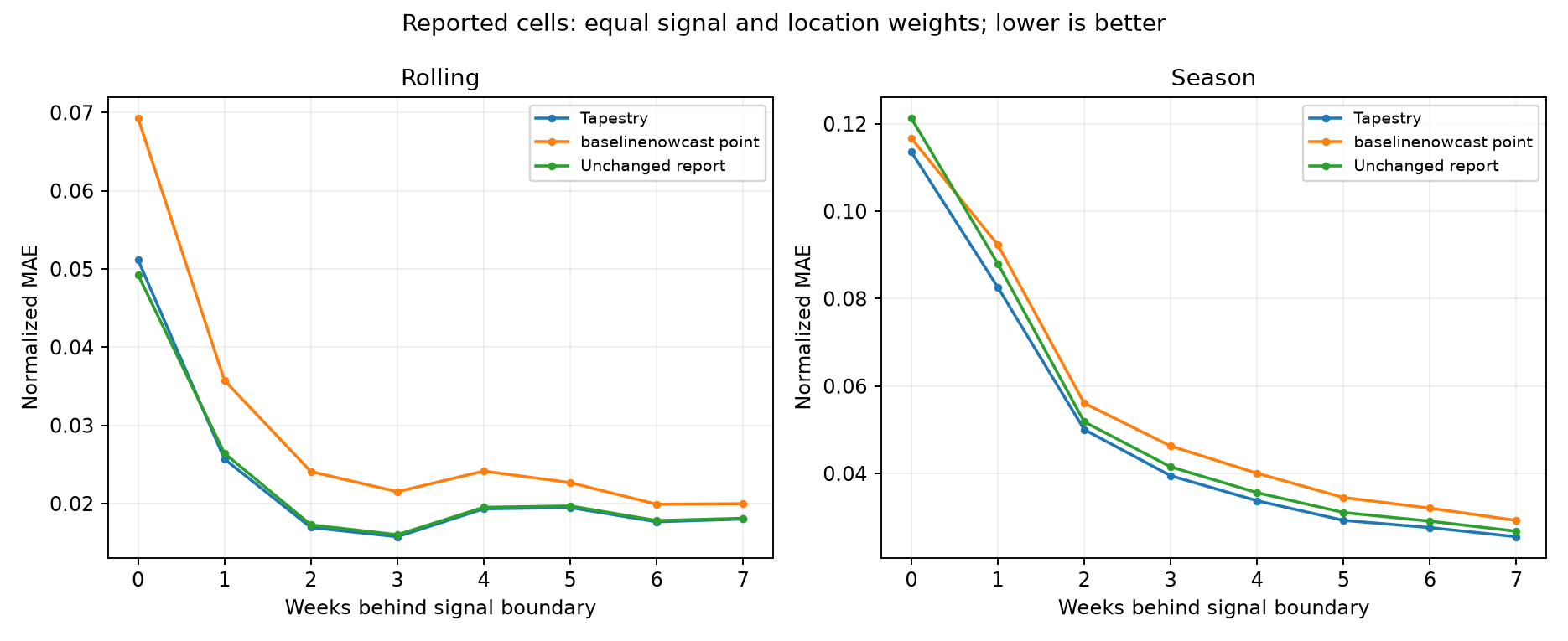
Summary CSV · Coverage CSV · Summary script.
Coverage is material: unsupported triangles retain persistence and missing
reports retain the documented fallback. In 2024–25 only 55,791 cells receive an
estimated baseline, while 84,070 reported cells have insufficient triangles and
66,923 cells have missing reports. All remain in their matched scoring groups.
The model's rolling reported-cell aggregate is also almost identical to
persistence, so improvement over this baseline alone is not evidence of a useful
improvement over unchanged reports. Stored per-cell predictions and baseline
provenance live under data/experiments/reporting-triangle-v11-20261001/.
Manager commands (the plan command is for fresh runs; the baseline command augments completed fits without retraining):
bash scripts/plan_finalization.sh reporting-triangle-v11-20261001
.venv/bin/python -m chromantis.experiment.planner baseline -e reporting-triangle-v11-20261001
.venv/bin/python -m chromantis.experiment.planner status -e reporting-triangle-v11-20261001
.venv/bin/python -m chromantis.experiment.planner rank -e reporting-triangle-v11-20261001
.venv/bin/python docs/experiments/reporting-triangle-20261001/baseline_report.py
Model
The nowcaster reconstructs eight weeks ending at each signal's T-X boundary. Each Wednesday it estimates how the available reports will mature, separately by signal and location. It permits upward and downward corrections, with an explicit option to retain the report.
Formulation and assumptions
The triangle stores C(t,d): the report for event week t at scheduled Wednesday delay d. Each weekly development factor is estimated over the most recent 52 eligible event weeks, then factors are multiplied through delay 12. This is a full-season-length estimation window, not a fixed eight-week fit. Eight weeks remains the output reconstruction window. All report pairs must be observed by the issuance; later reference labels are never inputs to the development curve.
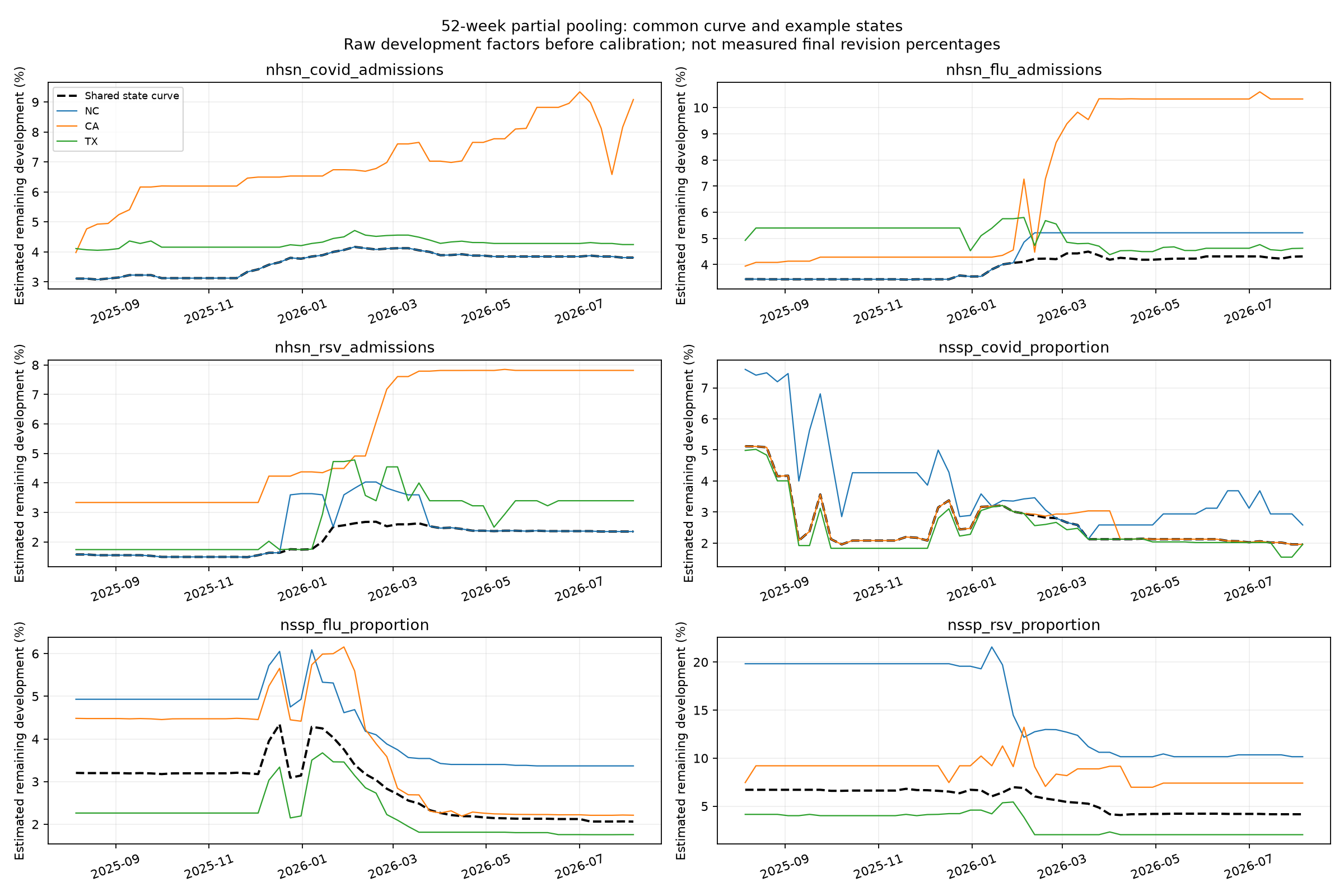
For each signal and delay, a common factor is the weighted median of paired ratios across states/DC. Each state has unit total weight in this shared fit; within a state, report exposure weights observations. At least three states with four observed pairs each are required. The native US aggregate is excluded to avoid double counting and is fitted independently.
Each state then fits its own weighted-median factor with 12 mean-exposure pseudo-weeks at the common factor. This is partial pooling: strong local history can differ from the common curve, while a sparse state borrows more. Fewer than four local pairs uses the supported common factor; without common support, the fallback is identity. US/national-only series retain a four-week identity prior. These prior strengths are fixed modeling assumptions, not fitted hyperparameters. National Kinsa remains one national series.
NHSN counts use C+1 to permit a correction to a reported zero. Continuous signals use C without an offset. The estimate is (report+offset)*development-offset, clipped nonnegative and to source-specific bounds; reported NHSN outputs are rounded to integers. Missing vintages are not zeros.
Assumptions: reporting patterns share a component across states; local departures are estimable; the preceding year's behavior informs the present; and 12-week reports approximate mature values. A complete fit can require roughly 64 weeks of archived vintages (52 event weeks plus 12 delays). Short archives use only observed pairs and are not described as a full season of training. The missing cell regression below is unchanged in this experiment.
Up to 52 weeks of pre-cutoff training Wednesdays fit reported-cell correction strength from 0, .25, .5, 1 separately by signal, reconstruction age, and US versus pooled states. Require six training Wednesdays and at least 1% training MAE improvement. These are fitted training parameters, not validation scores. Only the missing-cell regression retains the final 12 training Wednesdays for validation, with their event dates purged from inner training statistics. Triangle factors update causally during evaluation using available reports; reference labels never enter them. Calibration uses the frozen September 22 reference with a four-week age gap, so this remains retrospective calibration, not strict historical-label replay. The frozen reference is not guaranteed final. These reused evaluation folds are development evidence, not untouched confirmation or a forecast-benefit test.
The implementation is inspired by CDC nowcastNHSN
and baselinenowcast.
It is an independent point-estimate adaptation with robust fitting, not their
full probabilistic model. Inspected commits: nowcastNHSN
3eba887604fab1194343ae6ebaf29e6590d1248b; baselinenowcast
e7eb9749622c732e0277349738b5c79141afa4b4.
Cross-source missing-value component
A ridge regression predicts log1p(final/reference-scale) relative to a prior-week anchor. Inputs are Wednesday-visible signals at the event week and 1, 2, and 4 weeks before it, their availability masks, location indicators, annual phase, and reconstruction age. The current target report is always excluded, including for reported training examples. Own-source earlier values remain available. Input medians come only from inner-training visible vintages, separately by signal/lag/location; final covariate values are never features. National inputs may inform states, but national labels are not replicated as state labels.
Training weights decay with a 26-week half-life, renormalized so each location has equal total weight, and uses a fixed ridge penalty of 10. Fit on inner training, calibrate missing-cell blend strength on chronological validation (at least four validation Wednesdays, US and states separately), then refit on outer training. Output and feature scales are saved with coefficients. The model assumes cross-source associations transfer across the held-out period. It cannot reliably fill a new source with no historical training/validation support, and retains the fallback in that case. The log-space regression loss is a modeling choice; model acceptance uses native-unit normalized MAE.
Evaluation priorities and coverage
The six NHSN/NSSP targets are primary. Secondary outputs are the covariates in B2's best covariate model: inpatient claims, wastewater wval_like, Kinsa, ILINet, clinical-lab positivity, and FluSurv. B2's overall best model uses no covariates; its third-best uses only Kinsa. Outpatient claims and wastewater percentile ranks remain ancillary diagnostics and do not determine model selection. See the saved B2 ranking.
The main seasonal test is 2025–26: train before July 27, 2025. Recent rolling holdouts begin June 10, July 8 and August 5, 2026, each covering four Wednesdays. All six targets have scoring support in these tests. The 2025–26 covariate score covers four of nine selected signals (inpatient flu/COVID, ILINet, clinical lab); wastewater, Kinsa and FluSurv have no pre-cutoff training vintages. Recent rolling evaluation covers all nine, although some retain identity corrections when calibration history is insufficient. Reported and missing cells are shown separately, alongside all-cell error.
The 2024–25 test trains before July 28, 2024 and is a limited-coverage diagnostic: NHSN flu has 43 training Wednesdays, NSSP targets 14 each, and NHSN COVID/RSV have none. Wastewater, FluSurv and Kinsa also have no usable pre-cutoff vintage history. The NSSP series do not have the 24 Wednesdays required to reserve 12 for missing-cell validation; reported-cell strength uses their available training history. Inpatient claims, ILINet and clinical lab have about 114–115 weeks. These counts describe reporting vintages, not finalized-series length.
Using one common pre-2024 season to train for both evaluation seasons is chronologically valid but cannot provide training evidence for the missing archives. The two nowcaster seasonal fits are forward-only in date; B2's older 2024–25 evaluation instead included a later season in its training. The protocols must not be conflated. Frozen later reference labels still make this nowcaster experiment retrospective, as explained above.
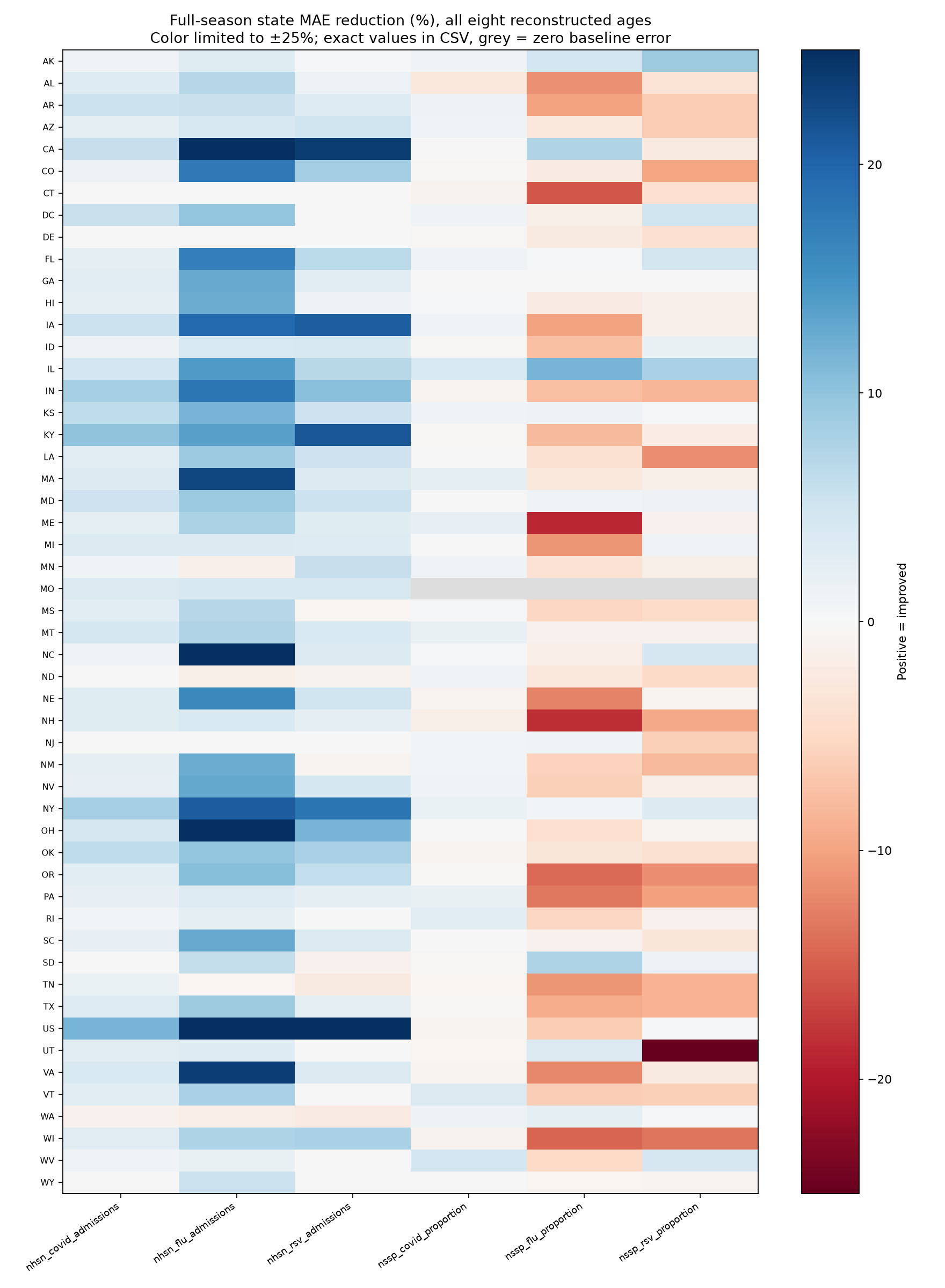
MAE is normalized by training-location means, with equal location weights. Within each age and protocol, average folds within signal, then signals equally; aggregate over the eight reconstruction ages. All-cell metrics include reported and missing examples using the same location weighting. Percent error reduction is 100*(1-model MAE/baseline MAE). Baseline means unchanged reported values and the prior-history/training-median fallback for missing cells. It is not forecast error reduction. These development folds have been reused during iteration.
The selected model retains pooled reported-value calibration and recency-weighted cross-source gap regression. State-specific reported calibration was rejected because it worsened the full 2025–26 target evaluation. Corrections are restricted to the priority outputs; outpatient and wastewater-rank outputs retain their baseline. Those sources may still enter as Wednesday-visible predictors.
Every fold and priority group · Reported/missing breakdown · Source-level diagnostics.
bash scripts/plan_finalization.sh reporting-triangle-v11-20261001
sbatch --job-name=reporting-triangle-v11-20261001 scripts/finalization.sbatch reporting-triangle-v11-20261001
.venv/bin/python -m chromantis.experiment.planner status -e reporting-triangle-v11-20261001
.venv/bin/python -m chromantis.experiment.planner rank -e reporting-triangle-v11-20261001
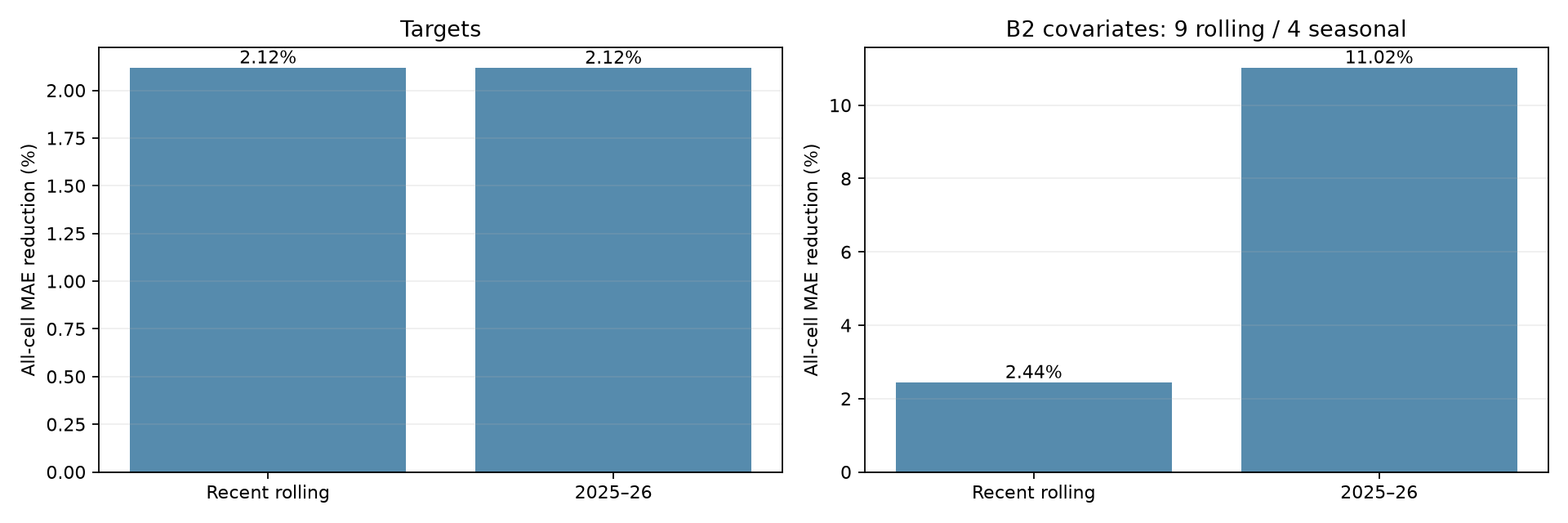
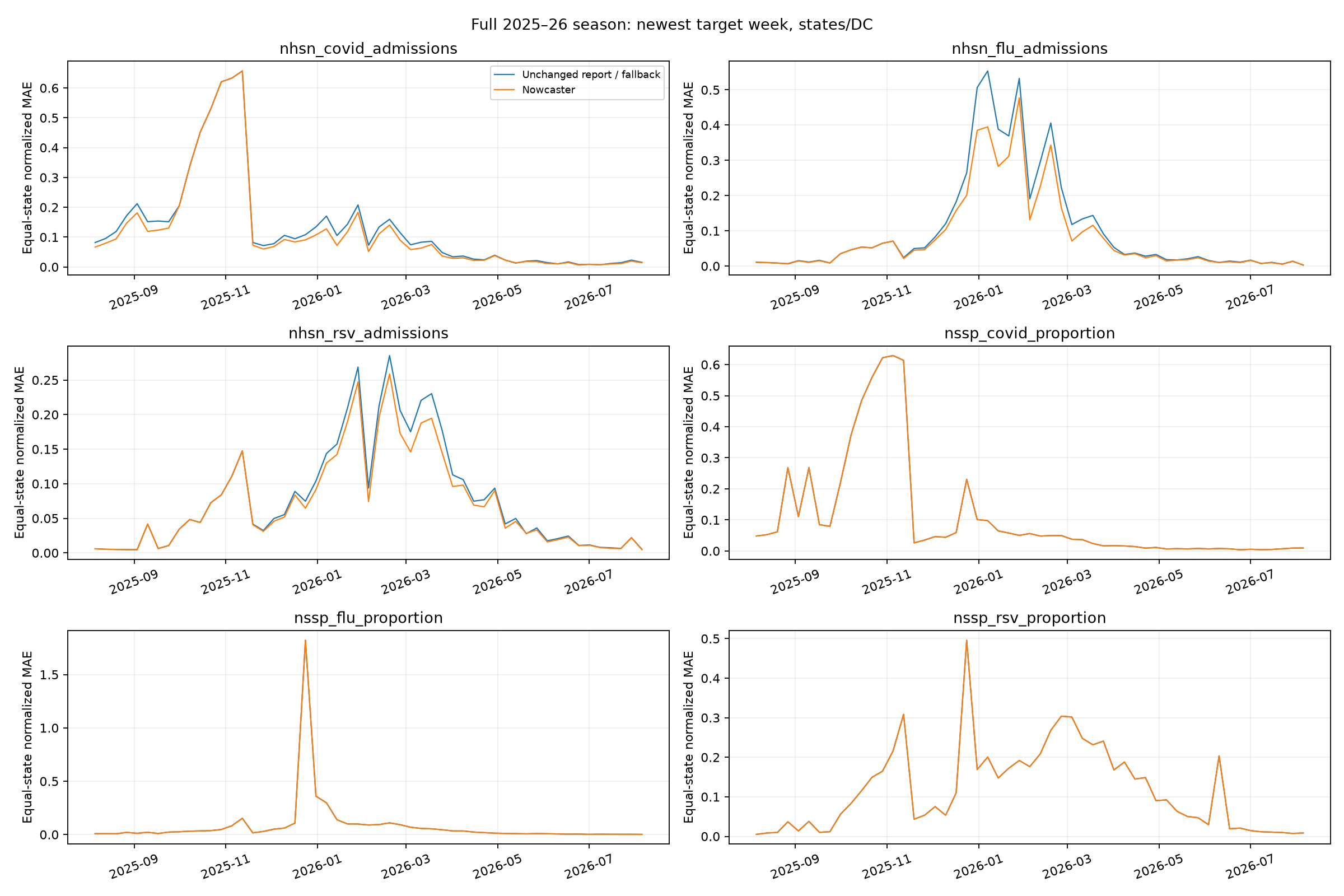
The full-season hierarchical evaluation completed on Longleaf (job 3300106, both configurations and all five folds). The current formulation removes 2.12% of all-cell target normalized MAE in 2025–26, and 6.44% for the newest reconstructed week alone. Recent rolling target error falls 2.12%. B2 covariate error falls 11.02% in 2025–26 (four supported signals) and 2.44% in recent rolling tests (all nine signals).
The result is mixed: the longer pooled fit improves recent rolling targets but does not beat the prior seasonal target result. Within 2025–26, reductions are 3.01% NHSN COVID, 8.90% NHSN flu, 4.36% NHSN RSV, and 0.42% NSSP COVID; NSSP flu and RSV errors increase 3.33% and 1.15%. Full-season pooling therefore does not yet establish a reliable improvement across all targets. Keep this as an evaluated nowcasting formulation, not a default replacement of forecasting histories. No composed downstream forecasting benefit has been measured.
The plots show the complete 2025–26 season, state-specific scores, and the common and local curves separately. The weekly error chart uses only age zero; state scores aggregate all eight reconstructed ages.
Decision log
October 1: switched to robust triangle fitting to reduce sensitivity to rare large revisions. Direct maturation was evaluated but reduced forward-season gains. Recent report-pair weighting was effectively a tie and was not retained. Conditioning on the current report level slightly improved rolling error but worsened seasonal error, so it was discarded. The simpler weekly triangle is retained. Superseded model implementations and report comparisons were removed.
The scenario's lookback=12 controls missing-value fallback history, not the
triangle archive window. Seed and epoch fields are inherited manager settings;
this estimator is deterministic and has no neural training epochs. Scientific
checks cover vintage causality, T-X alignment, purged label dates, equal-location
scoring, known development in both directions, rare revisions, and rate units.
Additional data-support findings
For the pre-July-2025 fit, NHSN flu has 95 training Wednesdays, NHSN COVID 36, NHSN RSV 35, and NSSP targets 66 each. Thus even this fit does not contain a full year of reporting vintages for every target. We cannot replace missing historical snapshots with finalized values and call them revision-training examples.
In the recent rolling windows, 83–93% of target cells across all eight ages are already exactly equal to the frozen reference (83% NHSN COVID, 88% NHSN flu, 90% NHSN RSV, 88% NSSP COVID/flu, 93% NSSP RSV). The newest week is less complete; older ages dominate the exactly-correct count. This is a diagnostic of the current sample, not a claim that the remaining errors are unpredictable.
October 1 continuation: prioritized outputs using the saved B2 ranking. Added causal cross-source gap regression and retained recency weighting for the main 2025–26 covariate result. Rejected state-specific reported correction selection. Kept reporting-triangle corrections pooled across states and restricted corrected outputs to the six targets and nine selected covariates. Older implementations and checkpoints were discarded; current-result plots contain no old-model curves.
October 1: expanded the development window to 52 event weeks and introduced a shared state curve with state-specific partial pooling at the user's request. National observations are excluded from the state pool. Shared/local factors are saved per prediction. The reconstruction horizon remains eight weeks; evaluation plots now explicitly show the entire season and newest-week errors separately.
October 1: fitted reported correction strength over up to 52 pre-cutoff training weeks as well. Missing-cell validation remains separate. The first launch stopped on string-array date reduction before producing results; the corrected run uses Python date-string ordering and the same scientific protocol.