Nowcaster research log · October 1–2, 2026
This records successive experiments. See the current result for the selected configurations and corrected scores.
Context-conditioned nowcasting · October 1–2, 2026
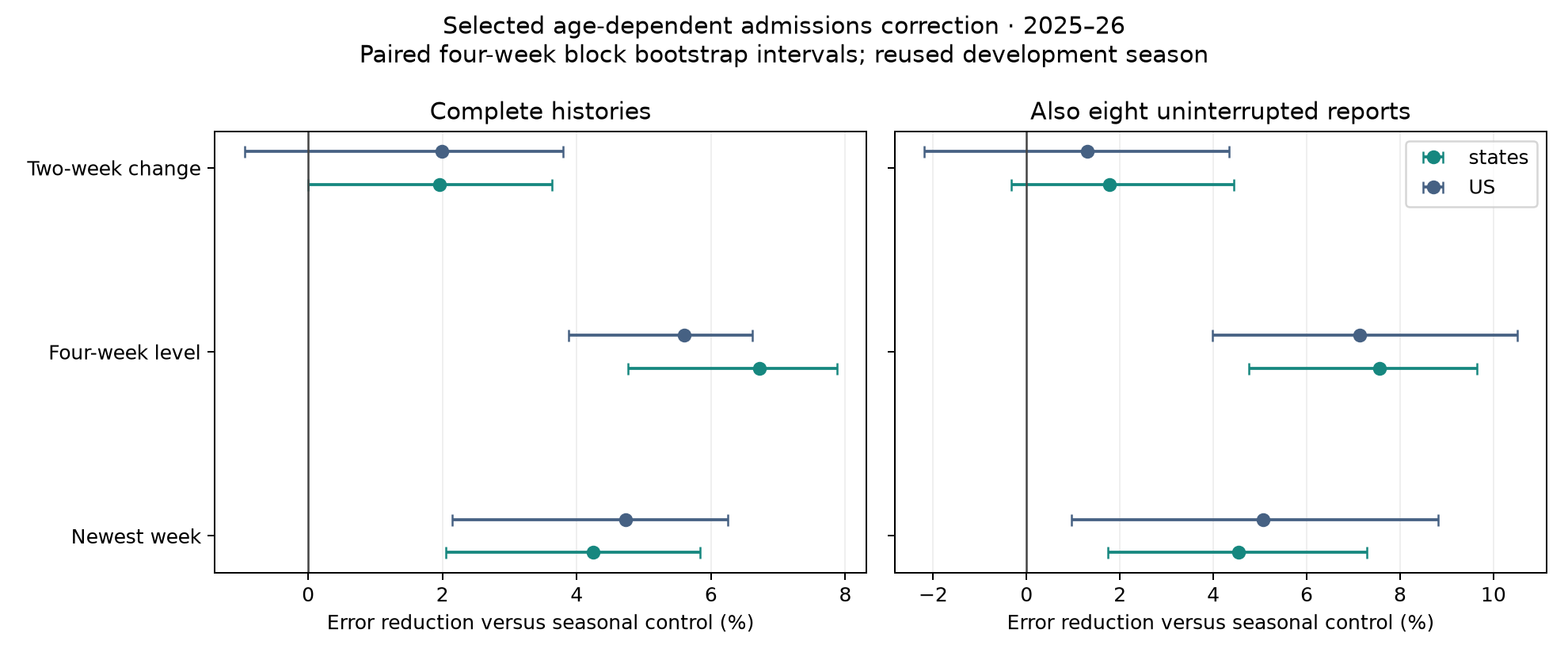
The strongest completed point nowcaster uses age-dependent residual correction for admissions and keeps the seasonal ED estimates. On 2025–26 complete histories, state newest-week WAPE improves 6.31% → 5.87%, four-week level error improves 6.7%, and growth error improves 2.0% (the growth interval still includes zero). Joint revision uncertainty improves C1 WIS 0.24% on complete histories, but still worsens it 0.39% with uninterrupted reporting. A smaller residual correction is being evaluated to resolve that tradeoff; no forecast default is promoted yet. Later sections record the successive finite comparisons and their manager commands. All runs use patron node 2.
Recent US level and growth · Recent NC level and growth · Current forecast comparison.
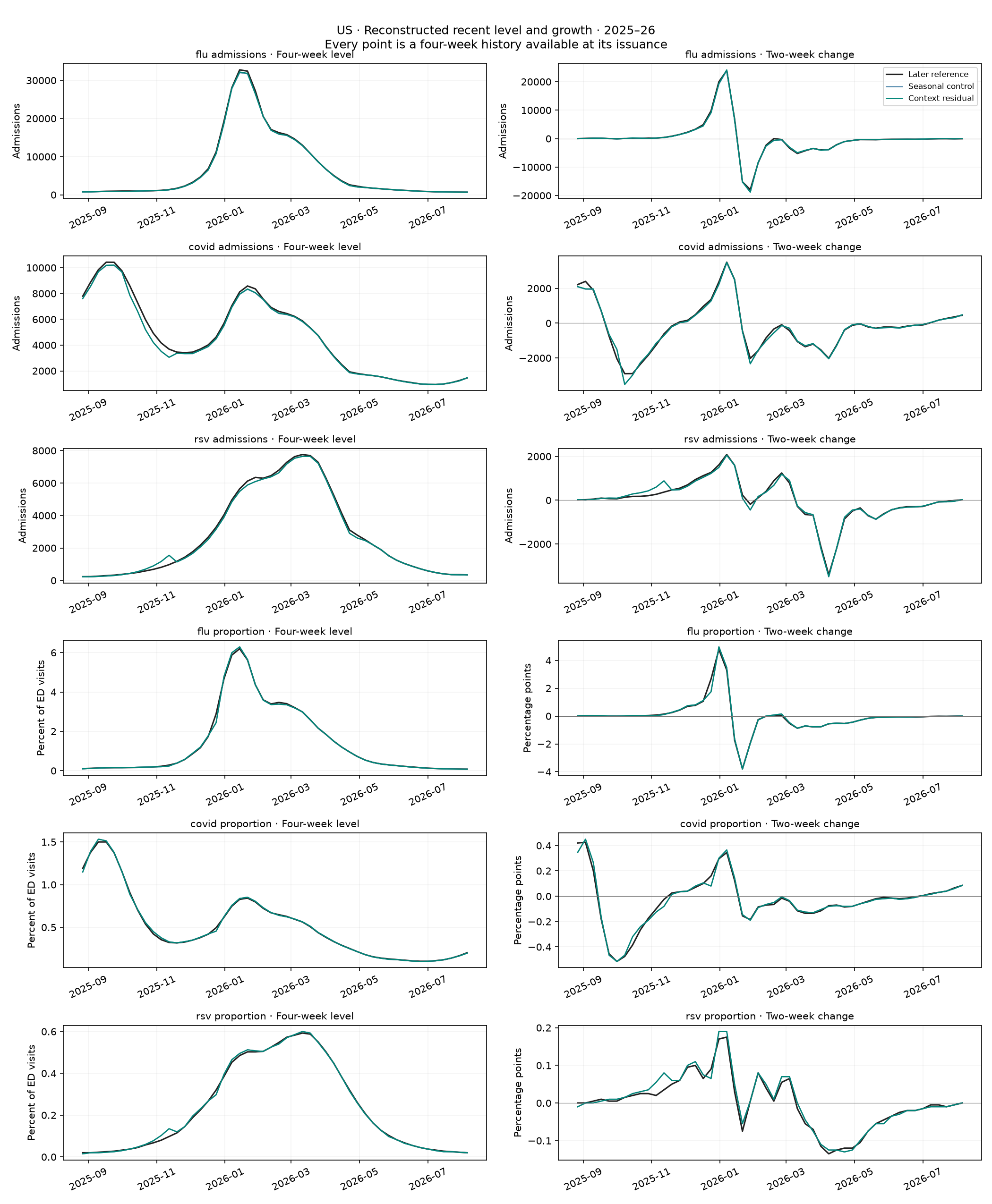
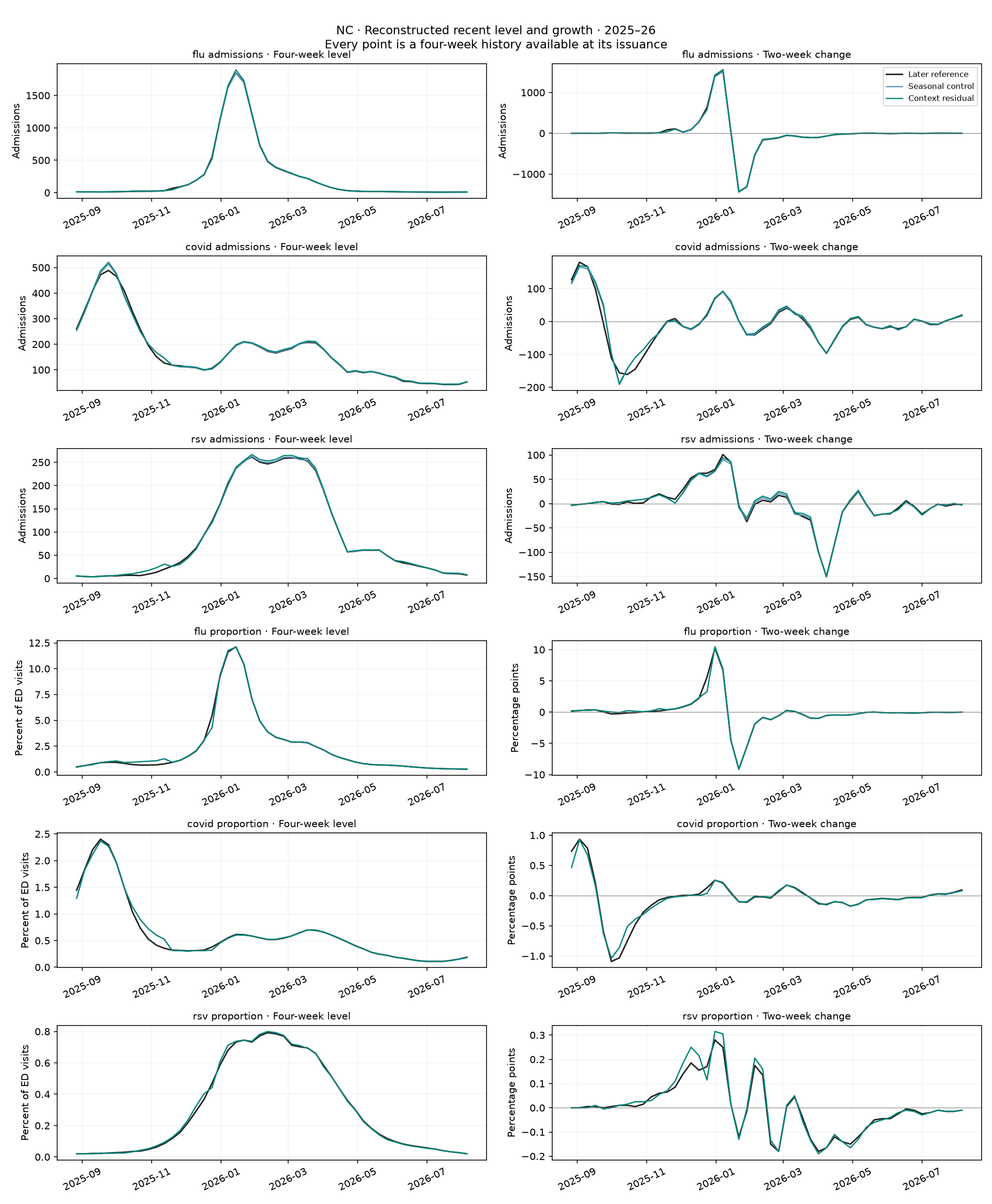
Improve the existing seasonal reporting triangle and the recent epidemic trajectory it supplies to forecasting. Complete target histories are primary; the intersection with eight uninterrupted reporting issuances is the stricter check. The previously explored 2024–25 and 2025–26 seasons are development data, not independent prospective validation. No 2026–27 outcomes are used.
Availability and scientific assumptions
Use the current human availability assumptions: six targets, Kinsa, inpatient/outpatient and NWSS through T-0; FluSurv, labs and ILINet through T-1. Apply this schedule even where the historical archive does not establish it. Native gaps (no finalized value) remain missing; Vermont inpatient remains unsupported. The earlier audit's source delays are not the current policy.
Availability alone does not specify the numerical contents of missing historical reports. For downstream scheduled-input replay, use the frozen reference as an explicit proxy where a target report is absent, and use scheduled finalized covariates as in B2. Preserve actual target reports wherever present. These proxy values include later revisions; scores involving them measure the assumed reporting environment, not historically deployable performance. Apply the same proxies to every arm. Do not use proxy pairs to learn reporting development, and do not count their exact reconstruction as evidence of nowcaster accuracy. Primary nowcaster comparisons use observed complete-history cohorts; availability flags for these cohorts always come from the unfilled archive. Here a complete history means all twelve context reports for the scored target/location are observed at that issuance. The stricter cohort additionally requires the latest report to have been present at each of the preceding eight issuances for that target/location. It does not require simultaneous completeness of every other input target. All arms are scored on identical task cells.
Models and training
Control: the existing adaptive-chain model, 104-week history, eight-week seasonal bandwidth, eight-week recent-pair half-life, exposure-weighted median factors, four effective prior weeks for state pooling, independent national estimation. All fitting uses only actually archived report pairs whose end report was available at that issuance. Delay 12 approximates maturity. Calendar and local reporting behavior are presumed transferable within the fitting window; signed revisions are allowed. No future frozen reference trains the candidate curves.
Candidates condition the same weighted-median fits on local epidemic growth and
holiday reporting. Growth is half the log ratio of the newest two-week mean to
the preceding two-week mean, measured at the same historical reporting delay as
the target estimate. It is computed from that historical issuance, not maturity.
Counts receive a one-count offset; rates receive no offset and nonpositive or
missing means have unknown growth. Growth is clipped to ±1 log-unit/week.
Historical contexts receive weight 0.25 + 0.75 exp(-0.5 (difference/bandwidth)^2);
unknown growth leaves the previous weights intact. Bandwidths 0.1, 0.2 and 0.4
are compared. This floor preserves support under sparse context.
Thanksgiving, Christmas and New Year define a reporting-week indicator and a following-week recovery indicator. Mismatched contexts receive one-quarter weight. Holiday dates are deterministic calendar features, not measured office closures. These are prespecified modeling choices; no external holiday data or new dependency is needed. Weekly-chain candidates condition every later step on the currently observable growth, assuming that regime remains informative over subsequent revision steps. A direct current-delay-to-12 candidate checks that assumption. Output rounding and the proxy gap model match the control.
Scores and selection
Save newest-week error and four-week trajectories on identical observations for all methods. Each trajectory must have four scored reference values and finite predictions from every comparator; partial trajectories are excluded explicitly. The first three boundary weeks of a seasonal fold cannot form full trajectories because their earlier ages lie outside that fold's scored labels.
- Point: absolute newest-week error / training Q95.
- Level: absolute error in the four-week mean / training Q95.
- Growth: absolute error in (newest two-week mean − preceding two-week mean) / training Q95. This remains defined at zero and reflects absolute change in epidemic burden.
- Trajectory: arithmetic mean of point, level and growth errors; this explicit equal-component utility is the development selection criterion. Preserve all components to expose tradeoffs.
- Log growth: secondary absolute error in half the log ratio of those two means, adding 1% of training Q95 to both means. The offset is an explicit near-zero regularizer; this diagnostic does not determine selection.
Average weeks within location, then locations within target/geography. Report states and US separately and target-macro scores. WAPE and within-5% accuracy remain secondary point diagnostics. Downstream WIS retains the shared manager's weights (20% US, 80% equally weighted states; admissions twice ED), fixed C1 checkpoint weights, three paired seeds and compatible availability encoding. A better trajectory score alone does not establish better forecasting.
Manager commands
Remote working directory: /proj/jlessler/projects/tapestry-all/nowcaster-20261001.
This source staging directory shares the existing data and environment but does
not overwrite the main remote checkout. The manager pins each experiment's code.
export PYTHONPATH="$PWD/src"
bash scripts/plan_context_nowcast.sh context-nowcast-v1-20261001
sbatch --job-name=context-nowcast-v1-20261001 --nodelist=g1803jles02 scripts/finalization.sbatch context-nowcast-v1-20261001
.venv/bin/python -m chromantis.experiment.planner status -e context-nowcast-v1-20261001
.venv/bin/python -m chromantis.experiment.planner rank -e context-nowcast-v1-20261001
Do not re-plan while a job runs. status provides the resubmission command;
retain --nodelist=g1803jles02 for this work.
Decision log
- October 1: started with conditional reweighting of the existing seasonal estimator to keep the implementation simple. Added matched level/growth scoring and scientific checks for vintage isolation, rate units, and score mathematics. Two focused tests passed. Figures are for user inspection.
First sweep result and revised training
All five kernel candidates completed (Longleaf job 3351522). The seasonal control won the specified 2025–26 complete-history trajectory criterion: 0.035860 versus 0.036764 for the least harmful kernel candidate (bandwidth 0.4, +2.5%). Bandwidth 0.2 scored 0.037043 (+3.3%); direct conditional completion scored 0.039832 (+11.1%). These fixed similarity weights are rejected as an improvement. The experiment's pinned source and score tables retain the comparison.
The second sweep learns a residual on top of the unchanged seasonal predictions. Its examples are past predictions actually generated using each historical issuance's information. Labels are scheduled delay-12 archived reports, admitted only when that delay-12 report has arrived. Complete historical four-week paths supply the level/growth examples. Reference truth and the evaluation fold's label mask do not construct these training examples. The wrapper builds them from vintages with dummy reference labels, independently of score support.
Assumptions and fixed choices:
- Fit each signal independently; states share growth/holiday slopes with ridge regularized local offsets, and US fits independently. Age-specific offsets, recent growth, a missing-growth indicator and holiday/recovery indicators predict an additional multiplicative adjustment to the seasonal estimate.
- Use up to 104 preceding issuance weeks; 26-week recency half-life; equal total initial weight per location. Require twelve historical issuances and complete four-week paths. Refit every four scheduled issuances. The seasonal base still updates weekly and incorporates recent partial revision pairs.
- Normalize training residuals by each location's Q95 of the admitted mature reports across admitted issuance/age examples (a mature event week can occur at several ages); minimum scale 1 count or 1e-8 rate units. This scale can update during the season using past reports. Evaluation scales remain the existing frozen training-label Q95, so all candidates are compared identically.
- Three iteratively reweighted ridge fits approximate absolute error in newest point, four-week level and two-week change, with equal weight for those three terms. An auxiliary point term across all eight ages has 1/8 weight per cell. A residual floor of 0.01 in normalized units stabilizes IRLS. Penalties 10, 100 and 1000 check regularization; this finite sweep is development tuning.
- Limit the extra multiplicative adjustment to ±50%, retain nonnegativity, and apply the same output resolution as the control. Before sufficient mature paths exist, keep the seasonal prediction.
- Supervision at delay 12 assumes remaining revisions are small. This can improve reconstruction of delay-12 values without necessarily improving the later frozen reference or forecasting; evaluate both rather than assuming transfer.
export PYTHONPATH="$PWD/src"
bash scripts/plan_context_nowcast.sh context-nowcast-v2-20261001 residual
sbatch --job-name=context-nowcast-v2-20261001 --nodelist=g1803jles02 scripts/finalization.sbatch context-nowcast-v2-20261001
.venv/bin/python -m chromantis.experiment.planner status -e context-nowcast-v2-20261001
.venv/bin/python -m chromantis.experiment.planner rank -e context-nowcast-v2-20261001
The development selection averages target-macro trajectory errors with 80% weight on states and 20% on US, evaluated on complete histories in 2025–26. All six targets receive equal weight here; downstream WIS keeps the established admissions/ED weighting. Seven focused checks passed across trajectory mathematics, causal report access, rate scaling, scheduled proxies and input/label alignment.
Selected residual model
All four second-sweep runs completed on node 2 (job 3352507). Select
finalization_model=context_residual,finalization_penalty=1000 using the declared
complete-history 2025–26 criterion: 0.034778 versus 0.035860 (3.0% lower). Penalties
100 and 10 scored 0.034878 and 0.035026. These differences are development
comparisons, not independent hyperparameter validation.
| 2025–26 condition | Geography | Newest-week WAPE, control → residual |
|---|---|---|
| Complete 12-week history | States | 6.310% → 5.903% |
| Complete 12-week history | US | 2.587% → 2.448% |
| Also eight uninterrupted reports | States | 5.975% → 5.596% |
| Also eight uninterrupted reports | US | 2.279% → 2.204% |
WAPE pools observations within each target then averages targets equally. On complete-history four-week paths, equal-location normalized point, level, and growth errors change by −3.62%, −5.24%, and −0.18% for states; nationally by −4.35%, −5.15%, and −1.52%. Growth improvement is weak: its block-bootstrap interval includes both improvement and degradation. Under the stricter continuity criterion, level error falls 7.71% for states and 6.28% nationally, while growth error rises 0.23% and 0.40%. The result primarily supports improved level reconstruction, not a convincing improvement in growth estimation.
State trajectory error falls 2.95%, with a four-week circular block-bootstrap 95% interval for its change of −4.35% to −0.85%. The stricter group changes −3.49% (−6.49% to −0.47%). National intervals include zero. Resample the full seasonal issuance calendar jointly across targets and locations, with 1,000 draws and seed 42; recompute equal-location/target means in each draw. A draw without any observations for a required target is excluded (one strict-cohort draw). These intervals describe within-season variability and do not account for selecting this model on these outcomes.
Complete trajectories cover 12,578 state and 249 US target/issuance paths; the stricter group contains 9,309 and 184. Newest-week point diagnostics have broader support because they do not require four scored labels. The fraction of positive state observations individually within 5% falls from 63.47% to 62.56% with complete histories, and from 64.06% to 62.72% in the strict group. National within-5% accuracy improves slightly. Better aggregate errors do not imply every cell improves.
The older 2024–25 complete-history trajectory result is effectively unchanged for states (0.071417 → 0.071284) and worse nationally (0.040475 → 0.041160). It has limited source support and does not establish cross-season generalization.
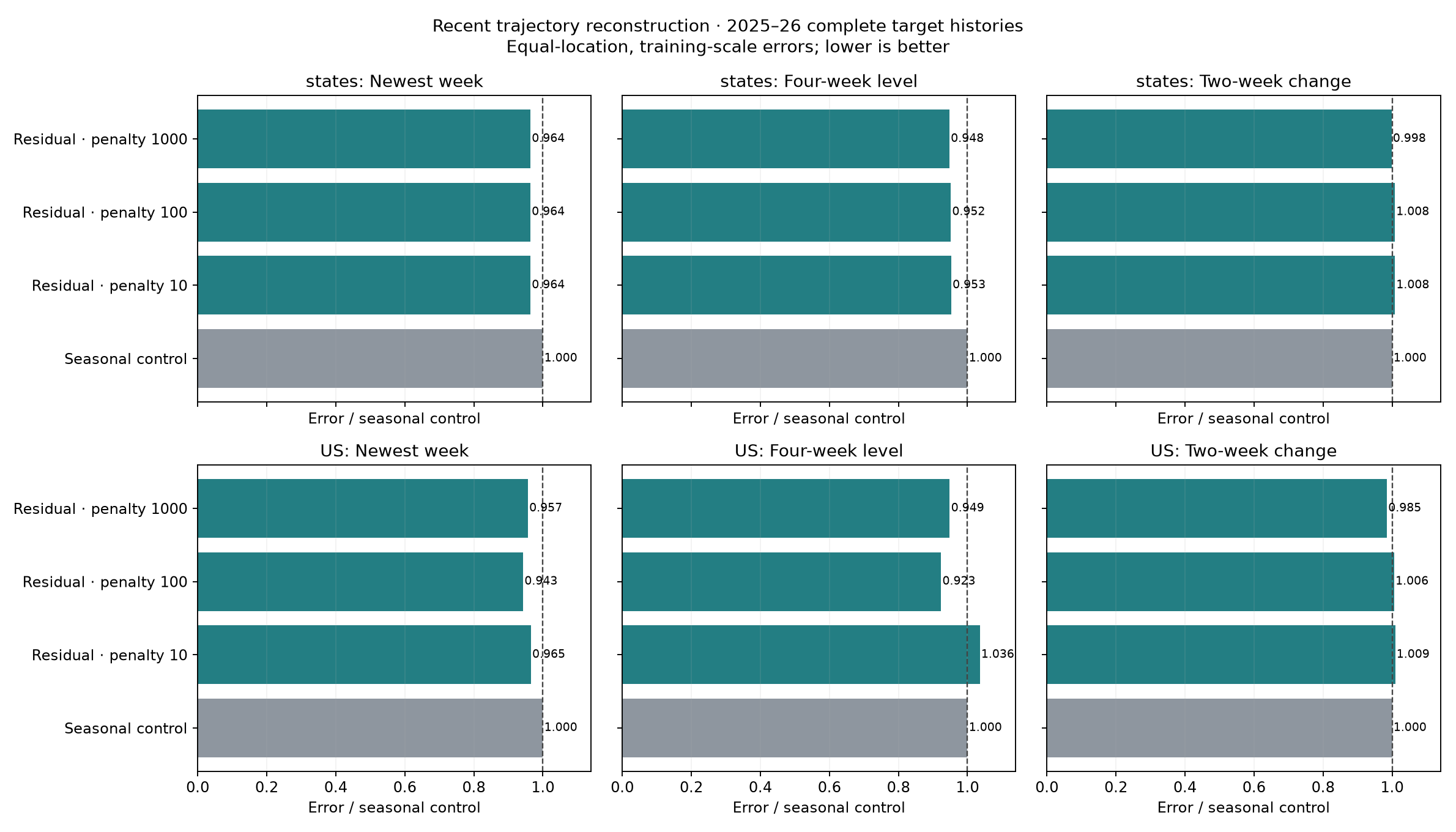
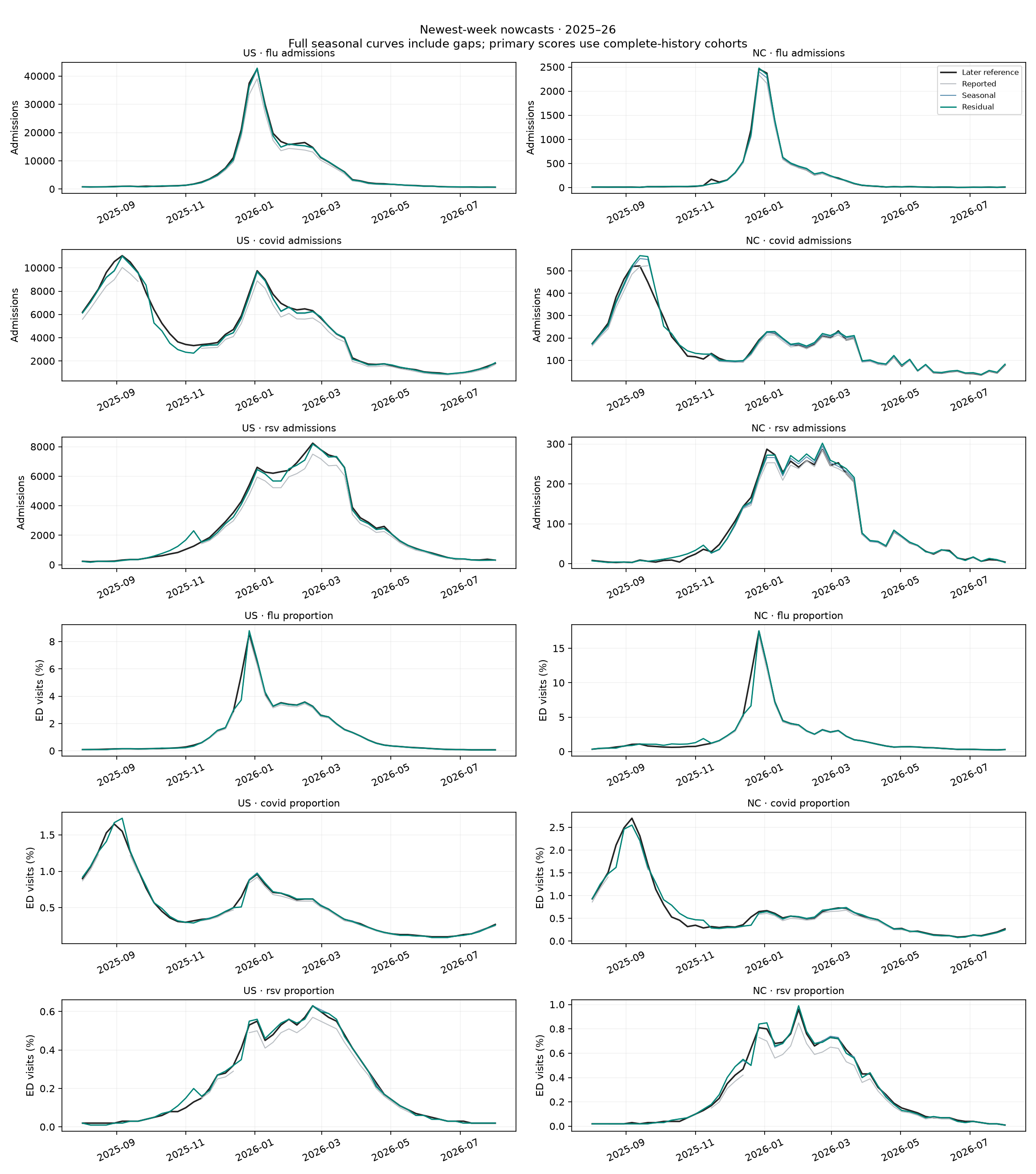
Trajectory scores · Point scores · Paired bootstrap · Selection.
Matched downstream C1 experiment
Use the selected residual model, the seasonal control, raw reports and finalized inputs. All use the documented schedule and B2-compatible input encoding. C1 has no ancillary covariates; the schedule still governs target inputs and the implementation supports the documented covariate schedule for other models. Point corrections replace the latest eight weeks. No nowcaster uncertainty is propagated. Do not interpret this experiment as retraining the forecaster.
Original C1 checkpoints and scales are fixed for seeds 42–44; draw 256 forecast members with paired evaluation seeds. Candidate predictions must reproduce the saved second-sweep finalization outputs before forecasting. The 2025–26 fold is the primary forward development check; the original 2024–25 C1 fold was trained using the later season as part of its leave-one-season-out protocol and is a secondary retrospective check.
export PYTHONPATH="$PWD/src"
.venv/bin/python scripts/plan_context_replay.py -e context-replay-v1-20261001 --nowcaster context_residual --penalty 1000
LANES=6 GPUS=1 sbatch --job-name=context-replay-v1-20261001 --nodelist=g1803jles02 --time=04:00:00 scripts/jlessler.sbatch context-replay-v1-20261001
.venv/bin/python -m chromantis.experiment.planner status -e context-replay-v1-20261001
.venv/bin/python -m chromantis.experiment.planner rank -e context-replay-v1-20261001 --no-plots
.venv/bin/python docs/experiments/context-nowcast-20261001/forecast_report.py -e context-replay-v1-20261001
GPU replay job 3352976; automatic aggregation job 3353048 runs the shared ranker
and the report above after successful completion. Reproduce that dependency with
sbatch --job-name=context-replay-report --dependency=afterok:JOB_ID scripts/context_report.sbatch context-replay-v1-20261001.
To regenerate the local nowcaster figures from completed artifacts:
.venv/bin/python docs/experiments/context-nowcast-20261001/report.py context-nowcast-v2-20261001
.venv/bin/python docs/experiments/context-nowcast-20261001/trajectory_details.py
First forecast result
All 12 runs / 24 fold evaluations completed. Forecasting reproduced the candidate on 204,972 saved nowcaster cells before applying the scheduling proxies. The finalized-input control also retained the original C1 labels and support.
| 2025–26 cohort | Final input | Raw reports | Seasonal nowcaster | Residual nowcaster | Residual vs seasonal |
|---|---|---|---|---|---|
| All matched tasks | 0.8919 | 0.9303 | 0.9293 | 0.9322 | +0.31% |
| Complete target history | 0.8890 | 0.9280 | 0.9267 | 0.9296 | +0.31% |
| Also uninterrupted reporting | 0.9583 | 0.9830 | 0.9784 | 0.9868 | +0.87% |
Values are WIS / matched Hub WIS under the standard scientific weighting, means of three paired seeds. Percentage changes average the paired seed ratios. All three seeds worsen on both priority cohorts. The older 2024–25 residual improves WIS 0.41% on complete histories and 1.33% on the strict cohort, but does not alter the primary 2025–26 conclusion. The first residual is a level-reconstruction improvement, not an established forecast improvement.
The availability assumption changes these numbers relative to the earlier 4.9%/2.5% degradation report. That earlier replay retained archive missingness; this experiment uses the requested scheduled-availability proxies identically across arms. Do not attribute the difference between those experiments to the new nowcaster.
In the complete-history 2025–26 comparison, the residual changes target WIS by −0.06% (flu admissions), +0.95% (COVID admissions), −0.22% (RSV admissions), −0.02% (flu ED), +0.72% (COVID ED), and +0.43% (RSV ED). For states, all three admission targets improve point, level and growth reconstruction, whereas ED improvements are weak or absent. A fixed forecaster trained on finalized inputs can respond poorly even to a more accurate reconstructed level.
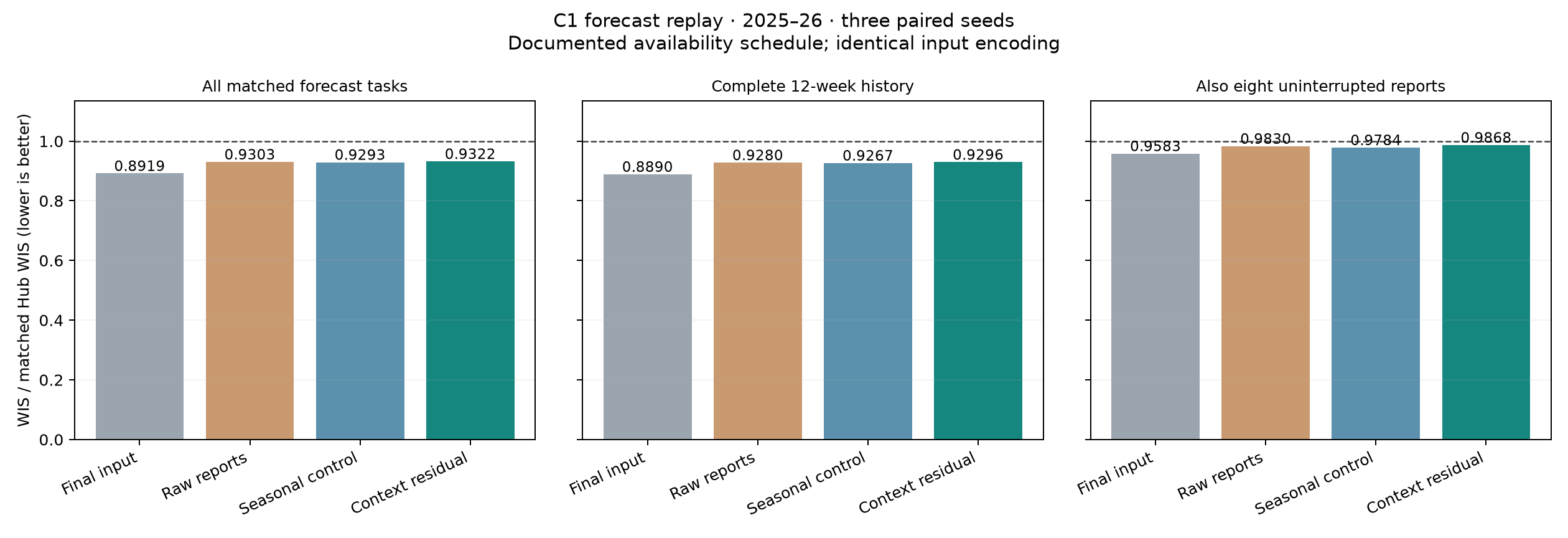
Forecast summaries · Paired seeds · Target scores · Horizon/target diagnostics · Coverage.
Growth-focused training check
A final finite ablation holds the evaluation criterion fixed while comparing
training growth weight 4 (versus 1), and residual recency half-life 8 weeks
(versus 26). The seasonal base remains unchanged. Rescale the combined training
weights by 4/(3 + growth_weight) so the nominal ridge strength is not changed
merely by giving growth more weight. Keep penalty 1000. This checks a training
tradeoff suggested by the weak growth result; it is additional development
selection on reused seasons, not a new validation sample.
export PYTHONPATH="$PWD/src"
bash scripts/plan_context_nowcast.sh context-nowcast-v3-20261001 trajectory
sbatch --job-name=context-nowcast-v3-20261001 --nodelist=g1803jles02 scripts/finalization.sbatch context-nowcast-v3-20261001
.venv/bin/python -m chromantis.experiment.planner status -e context-nowcast-v3-20261001
.venv/bin/python -m chromantis.experiment.planner rank -e context-nowcast-v3-20261001
Job 3353468 runs this comparison. No existing forecast or nowcaster default has been promoted on the basis of improved reconstruction alone.
Completed growth ablation and final decision
All four third-sweep runs completed. Stronger growth weighting scores 0.034941, and stronger growth weighting with the eight-week residual half-life scores 0.035125, versus 0.034778 for the previously selected residual. The selection criterion therefore retains penalty 1000, growth weight 1 and residual half-life 26. The repeated selected model produces exactly identical predictions on all 213,315 saved cells across the two seasons. Its existing C1 replay remains the applicable downstream test; there is no need to replay unchanged predictions.
The shorter-half-life candidate improves national growth error somewhat but trades away point/level accuracy and does not improve state growth. Do not select it using its best isolated metric after declaring a different primary criterion.
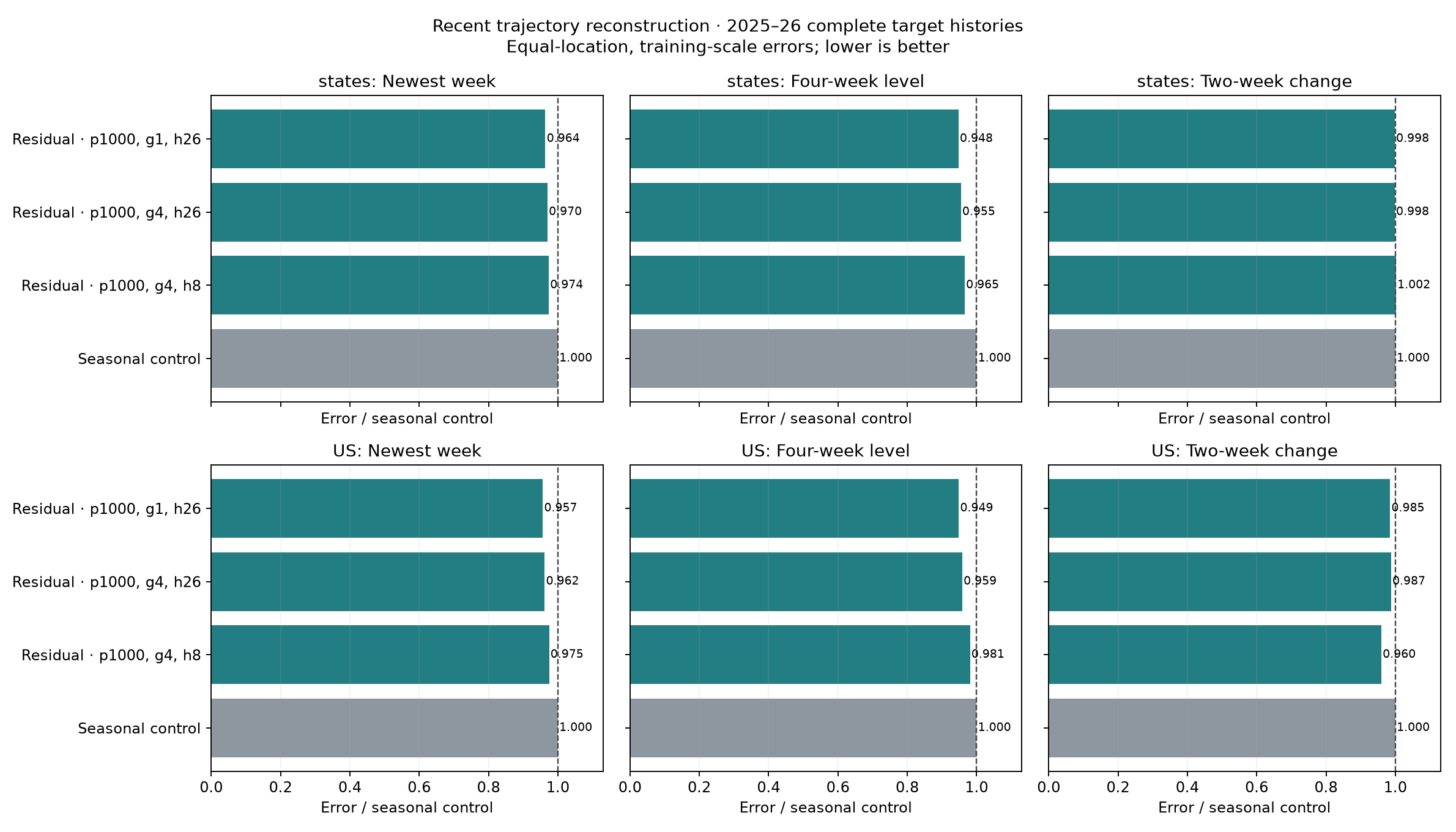
Growth-ablation selection · All component scores.
The completed work provides a reproducible level-oriented candidate and a scorer that exposes trajectory and downstream tradeoffs. It does not establish an untouched-season improvement, calibrated nowcast uncertainty, universal 5% point accuracy, or a forecast benefit. The stronger claim would require matched forecaster training and evaluation with these reconstructed inputs; changing that forecaster is outside this nowcaster comparison.
For the selected model alone, an exact fresh plan is:
export PYTHONPATH="$PWD/src"
.venv/bin/python -m chromantis.experiment.planner plan -e context-nowcast-selected-20261001 \
  -s 'task=finalize,input_mode=vintaged,lookback=12,finalization_weeks=8,finalization_scope=targets,finalization_gap=proxy,finalization_statistic=median,finalization_quantize=1,finalization_cv=season,evaluation_seasons=recent_two,finalization_model=context_residual,finalization_penalty=1000' \
  --seeds 42 --device cpu
sbatch --job-name=context-nowcast-selected-20261001 --nodelist=g1803jles02 scripts/finalization.sbatch context-nowcast-selected-20261001
.venv/bin/python -m chromantis.experiment.planner status -e context-nowcast-selected-20261001
.venv/bin/python -m chromantis.experiment.planner rank -e context-nowcast-selected-20261001
This last block is a reproduction recipe, not an additional launched run.
The completed selected artifacts already live in context-nowcast-v2-20261001
and its exact repeat in context-nowcast-v3-20261001.
Continuation: reporting momentum and causal correction strength
The fourth sweep (context-nowcast-v4-20261001, job 3355213 on patron node 2)
keeps the primary selection criterion fixed. It compares the seasonal control,
the residual with causal strength selection, added revision-momentum features,
their combination, and a residual restricted to admission counts. The last arm
is a development ablation motivated by the weaker ED result, not an independent
validation of a preselected target restriction.
Momentum compares the same event week at the current and previous issuance: the three event weeks preceding the latest event, plus the event being corrected. Counts use log ratios with offset one; ED fractions use no artificial count offset. Log ratios are clipped to ±1. Invalid comparisons get zero and an explicit missing indicator. Features only use reports available at issuance.
The causal strength rule chooses among 0, 0.25, 0.5 and 1 times the proposed residual. It scores original historical predictions whose four recent event weeks have all reached their actual delay-12 reports. It requires eight distinct mature issuances within a 38-week window (26 weeks plus the maturity lag) and complete original 12-week histories. Selection uses the same equally weighted point, level and growth loss, normalized by mature local Q95, with locations weighted equally. Each signal's states share a strength; US chooses independently. The zero correction wins ties; a nonzero correction requires at least 1% historical improvement. No forecast outcomes or retrospective frozen-final proxies enter this rule. These finite thresholds are modeling assumptions.
The past predictions used by the rule were produced causally at their original issuance. It does not refit a model on all available truth and score that model on its own fitted residuals. A synthetic check verifies future-report isolation, rejection of a harmful correction, and the lack of permission to correct before sufficient labels mature. Momentum alignment and native rate units are checked.
export PYTHONPATH="$PWD/src"
bash scripts/plan_context_nowcast.sh context-nowcast-v4-20261001 momentum
sbatch --job-name=context-nowcast-v4-20261001 --nodelist=g1803jles02 scripts/finalization.sbatch context-nowcast-v4-20261001
.venv/bin/python -m chromantis.experiment.planner status -e context-nowcast-v4-20261001
.venv/bin/python -m chromantis.experiment.planner rank -e context-nowcast-v4-20261001
The earlier decision above describes the first three sweeps. Further candidates remain development experiments on the same two seasons and must still clear the fixed-forecaster replay before claiming a forecast improvement.
The completed fourth sweep selects the admissions-only residual at 0.034414 (4.03% below the seasonal control's 0.035860). Momentum alone scores 0.034756; momentum plus causal strength 0.034964; basic residual plus causal strength 0.035000. The more elaborate alternatives do not beat the selected restriction. This is another within-development comparison, not evidence from an untouched season. Results.
The selected admissions model is replayed in context-replay-v2-20261001, GPU
job 3356933, with the same frozen C1 checkpoints, three seeds and availability
policy. Its report is kept separate in admissions-replay/.
export PYTHONPATH="$PWD/src"
.venv/bin/python scripts/plan_context_replay.py -e context-replay-v2-20261001 \
  --reference context-nowcast-v4-20261001 --candidate mlp-all-vintaged-ce82ebe7d71f
LANES=6 GPUS=1 sbatch --job-name=context-replay-v2-20261001 \
  --nodelist=g1803jles02 --time=04:00:00 scripts/jlessler.sbatch context-replay-v2-20261001
.venv/bin/python -m chromantis.experiment.planner status -e context-replay-v2-20261001
.venv/bin/python -m chromantis.experiment.planner rank -e context-replay-v2-20261001
Age-dependent level and slope corrections
The fifth sweep keeps the same training utility and selection criterion. It
replaces each shared context/local effect with two smooth age effects:
2^(-age/2) and age * 2^(-age/2). Separate age intercepts remain. The two-week
half-life is a fixed modeling assumption: additional reporting corrections
should diminish as reports mature, while their shape can change recent growth.
These effects remain linear in fitted coefficients and retain ridge shrinkage,
causal delay-12 labels, three IRLS steps and the ±50% multiplier bound. Unlike
a single multiplier shared across report ages, they can correct trajectory shape.
Compare penalties 100 and 1000, added momentum, and admissions-only restriction;
retain the seasonal control in the same managed experiment.
The fifth sweep is job 3357331. Its manager commands are:
export PYTHONPATH="$PWD/src"
bash scripts/plan_context_nowcast.sh context-nowcast-v5-20261001 age
sbatch --job-name=context-nowcast-v5-20261001 --nodelist=g1803jles02 scripts/finalization.sbatch context-nowcast-v5-20261001
.venv/bin/python -m chromantis.experiment.planner status -e context-nowcast-v5-20261001
.venv/bin/python -m chromantis.experiment.planner rank -e context-nowcast-v5-20261001
The completed admissions-only C1 replay still worsens WIS by 0.223% on complete histories and 0.676% on uninterrupted complete histories in 2025–26. It improves the older retrospective fold by 0.414% and 1.334%, respectively. Do not promote it as a forecast upgrade. Matched results.
Joint history uncertainty
Point estimation discards reporting uncertainty. A separate finite experiment passes intact draws of eight-week histories into fixed C1, one future per history. The latent draw ordering is preserved; a degenerate history bank reproduces the ordinary forecast quantiles (checked for global/local noise and pathogen bundles). This leaves forecaster weights, masks, flags, forecast labels and scoring unchanged.
The bootstrap learns log errors of original causal nowcasts against actual archived delay-12 reports. It uses a 104-week donor window with 26-week recency half-life, after all eight event weeks have matured. A single donor supplies the whole week × target × location error array. Each cell's weighted median log error is removed, centering the distribution on the selected point nowcast. This preserves paired reporting patterns but assumes their relative sizes transfer to the current epidemic; it is an empirical uncertainty model, not a mechanistic reporting posterior. Log errors are capped at ±log(4), with offsets of one count and 0.0001 ED fraction. Counts are rounded and ED draws bounded to [0,1].
At least twelve mature donor issuances and twelve observed donor errors per cell are required. Missing donor cells receive zero perturbation. This can understate uncertainty under sparse support, which is reported explicitly. Frozen-final availability proxies are never donors and are never perturbed. The donor cache contains original nowcasts from the two evaluation seasons, so early 2024–25 has a documented warmup period with deterministic histories. Only labels actually mature at issuance are eligible; later observations in the same season may inform later predictions, as in the existing online point estimator.
Compare uncertainty strengths 0.5 and 1 against the deterministic candidate. The history sampling seed is fixed at 42 across C1 checkpoints; it is separate from their paired forecast RNG. Primary forecast comparisons retain identical complete-history and uninterrupted-report support. Distribution diagnostics score the newest value, four-week mean, and recent-two minus older-two mean using exact empirical-distribution CRPS and 80% interval coverage. Their normalizer is the causal donor-maturity Q95 (floor one count or 0.0001 fraction), applied equally to the distribution and its deterministic center, then averaged equally over weeks, locations and signals. These proper scores assess the history distribution; forecast WIS determines whether its propagation helps C1.
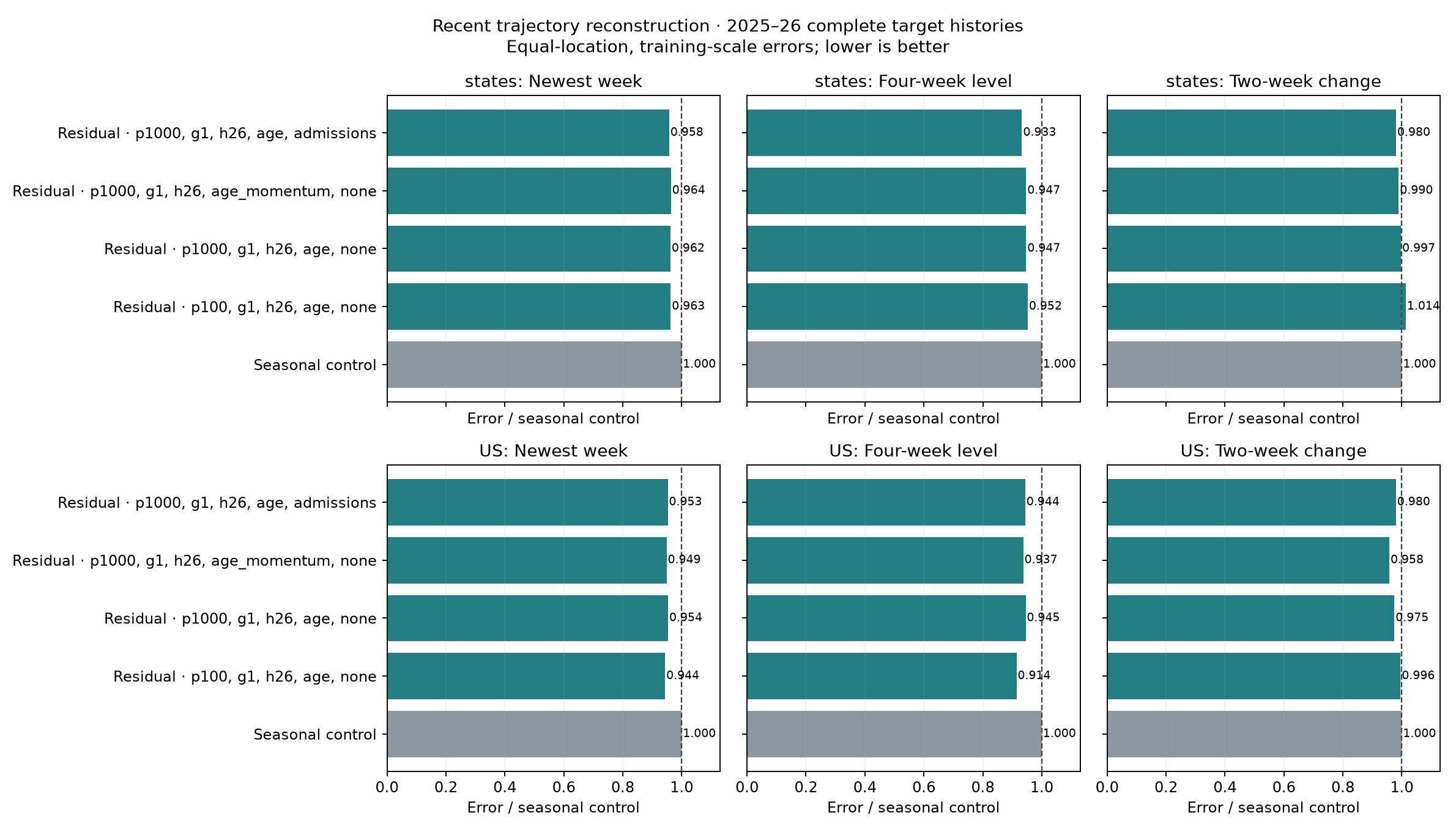
The completed fifth sweep selects age-dependent admissions correction, penalty 1000: trajectory score 0.034384, a 4.11% reduction from seasonal control. State newest-week WAPE is 5.874% (versus 6.310%). The normalized state point, level, and growth errors improve 4.24%, 6.72%, and 1.95%. Under uninterrupted reporting, those improvements are 4.54%, 7.56%, and 1.78%. Growth confidence intervals still include zero, so its smaller improvement remains less certain than the level gain. Age-ablation scores · Paired block bootstrap.
Replay context-replay-v3-20261001 (job 3364345) includes finalized inputs, raw
reports, seasonal control, the selected deterministic age/admissions candidate,
and candidate uncertainty strengths 0.5 and 1, each with three C1 checkpoints
and both folds (18 runs, 36 fold evaluations). Reports go in uncertainty-replay/.
export PYTHONPATH="$PWD/src"
.venv/bin/python scripts/plan_context_replay.py -e context-replay-v3-20261001 \
  --reference context-nowcast-v5-20261001 --candidate mlp-all-vintaged-eb672d2cc4de --uncertainty 0.5 1
LANES=6 GPUS=1 sbatch --job-name=context-replay-v3-20261001 \
  --nodelist=g1803jles02 --time=04:00:00 scripts/jlessler.sbatch context-replay-v3-20261001
.venv/bin/python -m chromantis.experiment.planner status -e context-replay-v3-20261001
.venv/bin/python -m chromantis.experiment.planner rank -e context-replay-v3-20261001
Forecast tradeoff and residual shrinkage
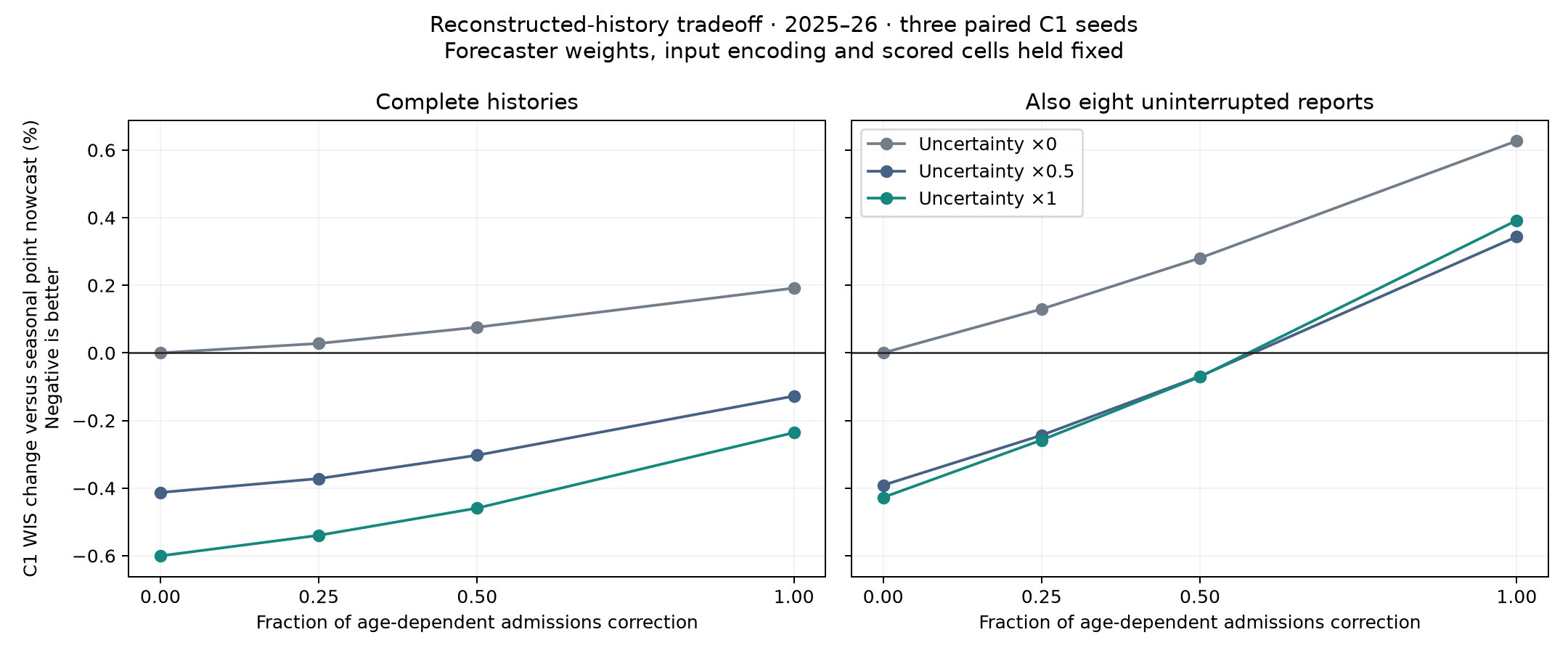
The first uncertainty replay completes all 18 runs. In 2025–26, the full-strength age-dependent point correction worsens complete-history C1 WIS by 0.192% and strict uninterrupted-history WIS by 0.627%. Adding full uncertainty changes these to −0.236% and +0.392% versus seasonal control; half uncertainty gives −0.128% and +0.344%. This is a small complete-history forecast improvement, but it does not yet clear both priority cohorts. Forecast table.
For the same candidate in 2025–26, half uncertainty reduces trajectory CRPS relative to its deterministic center by 5.5% in states and 17.5% nationally on complete histories. Full uncertainty gives 4.6% and 18.2%. Nominal 80% intervals still under-cover: full uncertainty's newest-point coverage is 63% in states and 60% nationally. The distribution is useful but not fully calibrated. The older fold's initial normalizer fell to its native-unit floor before donor support, producing unhelpfully large normalized scores. These early-fold diagnostic scores should not be used for model selection. Subsequent diagnostics use the observable current-history Q95 until a donor scale is available; forecasts and sampled histories are unchanged by this scoring correction.
The sixth point sweep compares full, half and quarter residual strength before native-unit rounding, with the seasonal control. It keeps the declared point selection score. The follow-on forecast comparison explores a Pareto tradeoff: accept a smaller reconstruction gain only if it also improves forecast WIS on both complete and uninterrupted complete histories. Do not call a smaller correction the best point nowcaster merely because it forecasts better.
export PYTHONPATH="$PWD/src"
bash scripts/plan_context_nowcast.sh context-nowcast-v6-20261001 strength
sbatch --job-name=context-nowcast-v6-20261001 --nodelist=g1803jles02 scripts/finalization.sbatch context-nowcast-v6-20261001
.venv/bin/python -m chromantis.experiment.planner status -e context-nowcast-v6-20261001
.venv/bin/python -m chromantis.experiment.planner rank -e context-nowcast-v6-20261001
The maturity audit finds 2025–26 admission reports at age four are still about 1.0–1.6% below age-twelve reports. Earlier labels would speed adaptation but introduce systematic supervision bias. Keep age-twelve labels in the residual and uncertainty fits. No early report is asserted final.
Across the first five sweeps, 18 distinct configurations were examined on reused development seasons. Cross-sweep table. Selection using only the older season would choose growth weight 4 and residual half-life 8, which still improves the 2025–26 trajectory score about 2.0%, but has only a 0.08% advantage on the older season itself. This is a stability diagnostic, not retrospective creation of an untouched validation set.
The sixth point sweep completes all four runs (job 3367082). The same full-strength model remains the point-score winner. Half strength retains a 2.61% primary trajectory improvement; quarter strength retains 1.44%. State newest-week WAPE is 6.042% and 6.162%, respectively, versus 6.310% for seasonal control. Quarter strength slightly improves the proportion individually within 5% (63.58% versus 63.47%), while the stronger point model lowers that proportion despite reducing aggregate errors. Strength comparison.
The matched follow-on context-replay-v4-20261001 runs all four correction
strengths (seasonal/zero, quarter, half, full) crossed with uncertainty strengths
0, 0.5 and 1, plus raw and finalized inputs: fourteen configurations, three C1
seeds, two folds. Job 3368578, report job 3368843. This checks the tradeoff using
the same checkpoints, task support and paired latent draws. Half strength is the
planner's reference candidate label; it is not predeclared the overall winner.
The full factorial results, rather than only that reference label, determine
whether any reconstruction/forecast compromise is supported.
export PYTHONPATH="$PWD/src"
.venv/bin/python scripts/plan_context_replay.py -e context-replay-v4-20261001 \
  --reference context-nowcast-v6-20261001 --candidate mlp-all-vintaged-5db50fe96ee7 \
  --additional-strengths 0.25 1 --uncertainty 0.5 1 --seasonal-uncertainty 0.5 1
LANES=6 GPUS=1 sbatch --job-name=context-replay-v4-20261001 \
  --nodelist=g1803jles02 --time=04:00:00 scripts/jlessler.sbatch context-replay-v4-20261001
.venv/bin/python -m chromantis.experiment.planner status -e context-replay-v4-20261001
.venv/bin/python -m chromantis.experiment.planner rank -e context-replay-v4-20261001
For forecast uncertainty intervals, resample four consecutive issuance weeks in circular blocks, keeping horizons, locations, targets and paired arms together. Recompute each location's model/Hub WIS ratio inside each bootstrap, then apply the shared scorer's geography and target weights and average paired changes over the three fixed C1 seeds. An exact check requires the unresampled calculation to match the shared scorer. These intervals describe week sensitivity; they do not account for trying multiple candidate models or provide prospective validation.
The first paired forecast bootstrap (full point correction plus full uncertainty) has a complete-history WIS change interval of −1.28% to +1.33%, and an uninterrupted-history interval of −1.13% to +1.79%. Neither establishes a stable forecast gain. Of 1,000 proposed week resamples, 917 and 656 have positive Hub WIS denominators in every original target/location group. Reported intervals are conditional on those valid resamples; sparse low-burden groups limit this relative-score bootstrap. Do not hide that rejection rate or describe these intervals as accounting for model-selection uncertainty.
Complete strength/uncertainty comparison
All 42 factorial replay runs finish. Quarter correction with half uncertainty improves 2025–26 mean C1 WIS by 0.372% on complete histories and 0.244% with uninterrupted reports. It also retains a 1.44% point-trajectory improvement. The three complete-history seed changes all improve (−0.538% to −0.221%); the strict cohort ranges from −0.538% to +0.086%. The same candidate improves older 2024–25 WIS by 0.148% and 0.419%, respectively (retrospective C1 fold).
Seasonal-center uncertainty forecasts better than any residual correction in this factorial comparison: half uncertainty improves WIS 0.413%/0.391% on the two priority cohorts and improves every seed. The balanced candidate gives up some of this forecast benefit to improve the reconstructed point trajectory. Full residual correction is still best for point accuracy. These are distinct choices on a tradeoff, not a single configuration winning every score.
All forecast combinations · Paired seeds · Distribution scores.
The uncertainty distribution is centered at the point estimate in log-median space; it does not preserve the arithmetic mean. Forecast improvement cannot be attributed solely to wider intervals. On complete histories the balanced candidate's underprediction component falls from 0.36324 to 0.34385, while its dispersion rises 0.27342→0.28201 and overprediction rises 0.29006→0.29738 (location/target-weighted components relative to Hub WIS). Their sum gives the small net gain. Keep all three components when interpreting this intervention.
Higher-member confirmation
Fix quarter residual and half uncertainty as the reconstruction/forecast compromise, then rerun 2,048 members versus the exploratory 256. Include the seasonal-center half-uncertainty comparator, deterministic candidate, and the three original input controls. This is Monte Carlo precision confirmation on the same data, not new external validation. Two H100 allocations on node 2 run job array 3370809; report job 3370995 also computes the paired week bootstrap.
export PYTHONPATH="$PWD/src"
.venv/bin/python scripts/plan_context_replay.py -e context-replay-confirm-20261002 \
  --reference context-nowcast-v6-20261001 --candidate mlp-all-vintaged-4498052c695b \
  --uncertainty 0.5 --seasonal-uncertainty 0.5 --eval-members 2048
LANES=6 GPUS=2 sbatch --job-name=context-replay-confirm-20261002 --array=0-1 \
  --nodelist=g1803jles02 --time=04:00:00 scripts/jlessler.sbatch context-replay-confirm-20261002
.venv/bin/python -m chromantis.experiment.planner status -e context-replay-confirm-20261002
.venv/bin/python -m chromantis.experiment.planner rank -e context-replay-confirm-20261002
Confirmed result and final diagnostic correction
All 18 higher-member runs complete. Quarter correction with half uncertainty improves C1 WIS by 0.413% on complete histories and 0.272% on uninterrupted complete histories at 2,048 members. The paired week-block intervals are [−0.829%, +0.205%] and [−0.917%, +0.397%], conditional on 917/1,000 and 656/1,000 valid relative-score resamples. Every complete-history seed improves; one strict seed worsens by 0.135%. Older-season means improve 0.159% and 0.430%. These are reproducible, modest development-set gains, not established prospective superiority. Seasonal-center uncertainty alone remains the strongest C1-only choice, improving both cohorts 0.45% and 0.41% without changing point estimates.
The final history-score normalizer fallback uses raw observed history Q95,
not the candidate's corrected history Q95. This guarantees that changing a point
center cannot change its fallback scoring denominator. Mature donor Q95 remains
the first choice. A scientific test checks candidate independence and future
isolation. Re-score all uncertainty diagnostics from the original cached points
and original draw counts using rescore_histories.py. Exact 80%-coverage parity
checks verify unchanged history draws/support. Forecast artifacts, fitted
corrections, WIS, and the declared point-trajectory score do not change. The
updated diagnostic CSVs and their distribution-score-provenance.json supersede
earlier normalizations in this log, in both seasons.
The confirmed balanced model reduces trajectory CRPS versus its deterministic center by 6.66% in states and 16.65% nationally on complete histories; reductions are 9.94% and 18.72% on the strict cohort. Its central 80% newest-week intervals cover only 54% of state outcomes and 43% of national outcomes on complete histories. Do not present these empirical forecast-input draws as calibrated 80% nowcast intervals. Current findings and commands are consolidated in index.md.
User-requested comparison against unchanged reports · October 2
The user asked whether improvement was impossible and requested mean errors at t−0, t−1, and t−2 against keeping reports unchanged. Re-scored saved v6 point predictions, without fitting new models. Keep the current vintage's actual report as the comparator. Anchor cohorts at t−0 and require identical finite support at all three ages and across seasonal, quarter, and full corrections. Use frozen final truth; no missing-report final proxies. Aggregate WAPE equally over six targets and additionally save native equal-location MAE, signed bias, normalized MAE, and equal-location WAPE. Do not mix counts and proportions in one native MAE. Per-target ED MAE is stored as fractions.
Balanced complete-history state WAPE is 9.193→6.173%, 3.411→3.200%, and 2.246→2.158% for ages 0, 1, 2. US is 8.061→2.540%, 2.626→1.958%, and 1.720→1.282%. Strict-cohort results and exact support are in index.md and age-error-summary.csv. State flu ED age-1 MAE worsens; aggregate gains are not universal. Calling the whole nowcaster mediocre based only on tiny incremental gains over an already useful seasonal correction was too broad. These results show a substantial newest-week benefit over raw reports, without establishing that richer corrections solve trajectory reconstruction or calibration.
Commands supplied with this analysis (existing training complete; not relaunched):
bash scripts/plan_context_nowcast.sh context-nowcast-v6-20261001 strength
sbatch --nodelist=g1803jles02 scripts/finalization.sbatch context-nowcast-v6-20261001
.venv/bin/python -m chromantis.experiment.planner status -e context-nowcast-v6-20261001
.venv/bin/python -m chromantis.experiment.planner rank -e context-nowcast-v6-20261001
PYTHONPATH=src .venv/bin/python docs/experiments/context-nowcast-20261001/report_age_errors.py