C1 training with locally matched historical nowcast errors
The earlier negative result applies to one error simulation, not to every way of training on reporting errors. This batch retrains C1 using four alternatives. No improvement is assumed before the runs finish.
What is trained and evaluated
C1 is the B2 pathogen-specific MLP with distance-based spatial sharing, no external covariates, a 12-week context, and a logit ED transform. All treatments remove the finality channel, retain finalized future prediction labels, and retain the original history, 300-epoch cap, patience 30, and seeds 42, 43, 44. Reporting augmentation does not hide additional observations. The pre-existing B2 20% artificial masking regularizer remains in all training conditions.
| Evaluation season | Forecaster training seasons | Season supplying error windows | Interpretation |
|---|---|---|---|
| 2024–25 | 2022–23, 2023–24, 2025–26 | 2025–26 | Retrospective leave-one-season-out CV |
| 2025–26 | 2022–23, 2023–24, 2024–25 | 2024–25 | Forward relative to forecaster training |
This retains the requested two-season B2 CV, rather than claiming two independent prospective tests. Historical vintages before 2024–25 lack sufficient newest-week support across targets. A forward-only 2024–25 error-training fold would need a different archive/support protocol. Both seasons have been used for development.
At evaluation every model receives actual Wednesday reports corrected by the same causal adaptive-chain nowcaster, with actual availability and finalized future outcomes used for scoring. No evaluation truth fills input gaps. The nowcaster corrects the latest eight context weeks; the older four weeks keep actual vintage values. Error extraction mirrors that exact input treatment.
Compare against the completed matched C1 trained on finalized inputs and the completed C1 trained with the earlier numerical-error-only simulation, using identical evaluation inputs, three seeds, dataset, frozen support, 256 prediction members, and scoring weights. These comparisons reuse completed checkpoints' scores; each new treatment trains fresh C1 weights.
Four training-input treatments
- Local seasonal log: match each location's recent levels and changes across six signals, together with circular seasonal timing; transfer signed log errors.
- Local seasonal log, half strength: use the same matching but multiply each log error by 0.5 before applying it. This shrinks both bias and variability.
- Calendar log: use seasonal timing alone to choose same-location error windows; transfer the same signed log errors.
- Local seasonal additive: use local seasonal matching, but transport normalized additive errors. This distinguishes matching from transport scale.
A donor always retains its original location, signal, and reporting age. One 12-week donor block supplies all six signals for each recipient location. Donor locations never exchange errors. Different locations can choose different donor weeks, so this preserves within-location temporal and signal dependence but does not preserve cross-location synchrony. This is a material assumption, especially because C1 shares information across locations.
Local matching uses latest-two-week and preceding-two-week available means, divided by the permitted training-season location/signal peak. Log level uses an offset of 0.05 and bandwidth log(2); two-week log change uses bandwidth 0.5. The mean squared feature difference is added to squared circular seasonal week distance divided by eight weeks. Calendar phase accounts for 52/53-week seasons. Missing local phase uses calendar only. Select among eight nearest windows with weights proportional to exp(-distance/2); exclude the identical origin. These bandwidths are fixed assumptions, not tuned on held-out scores.
For each reference week, define f as max(5% of that week's training-season location/signal peak, 1 admission or 0.0001 ED fraction). The log error is log((donor nowcast + f)/(donor final + f)). Apply it as max(0, (recipient final + recipient f) * exp(strength * error) - recipient f). The additive treatment uses (donor nowcast - donor final)/max(donor final, f) and rescales with max(recipient final, recipient f). Bound ED proportions by one. Keep rescaled admission counts continuous. Preserve signed bias; do not recenter errors. At a season boundary, target floors follow each reference week's season, not the window's origin season.
A donor cell without final truth or a finite nowcast/report supplies no numerical perturbation. It does not make a recipient cell missing. Lack of supported errors therefore still understates uncertainty in sparse cells; this batch cannot recover an unobserved reporting-error distribution. Season-specific scaling and local matching improve conditional transport but cannot establish stability of reporting rules between years.
Leakage controls and interpretation
Outer held-out reference dates are excluded from donor truth, matching features, peaks, and nowcaster reporting-pair histories. Inner early-stopping validation reference dates are excluded in the same way. Validation inputs get one fixed synthetic draw per seed; their finalized prediction labels stay unchanged. The full refit restores permitted validation weeks. The masked nowcaster archive may itself alter residuals; that inherited restriction remains in all four arms and is not claimed to have been validated as an optimal residual estimator.
Nowcast numerical caches are reused only because the nowcaster, dataset, and fold masks are unchanged; their source hashes and masks are checked at runtime. No old forecaster weights are used for new fits. Code snapshots isolate this batch from other experiments. Scientific checks cover label/mask preservation, held-out/validation exclusion, residual sign/inversion, and age/location alignment.
Report each season and paired seed changes before the combined score. Lower weighted WIS is better; ratios below one beat the matched Hub. Native US gets 20% weight and states/DC 80%; admissions weight 1 and ED 0.5. The 2024–25 support contains flu/COVID admissions, while 2025–26 contains all six targets. Three seeds measure training variability, not independent-season uncertainty. Choosing a winner among four methods on these reused folds is exploratory.
Manager commands
Run on Longleaf in /proj/jlessler/projects/tapestry-all/tapestry-c1-error-cv-20261002.
The planning script calls the shared planner with four explicit scenarios and
pins the dataset, evaluation support, seeds, and code snapshot.
export PYTHONPATH="$PWD/src"
.venv/bin/python scripts/plan_c1_local_errors.py -e c1-local-errors-20261002
LANES=6 GPUS=2 sbatch --job-name=c1-local-errors-20261002 --array=0-1 --nodelist=g1803jles01 --cpus-per-task=8 --mem=64G scripts/jlessler.sbatch c1-local-errors-20261002
.venv/bin/python -m chromantis.experiment.planner status -e c1-local-errors-20261002
.venv/bin/python -m chromantis.experiment.planner rank -e c1-local-errors-20261002 --no-plots
.venv/bin/python docs/experiments/c1-local-errors-20261002/report.py
After planning, use status to resume; do not re-plan an existing experiment.
Decision log
October 2, 2026: reopened the earlier negative augmentation result at the user's request. The earlier method chose donors by national phase and transported additive errors; neither choice establishes that nowcast residual training is ineffective. Replaced that transport code with explicit local/calendar matching and log/additive choices, and planned a four-treatment batch. Preserved the existing CV, nowcaster, labels, and matched finalized-training reference so the batch focuses on how historical errors are applied. No coding defect or improved forecast performance has yet been established by these methodological concerns.
Launch and input audit
Slurm training array 3457823 was submitted on October 2, 2026, using two L40 GPUs on g1803jles01, with six concurrent seed runs per GPU. Dependent report job 3457832 ranks the completed runs and generates the comparison graph. The launch also queued the standard ntfy completion summary. Twelve seed runs each contain two fold fits. Five focused scientific tests passed locally. The real nowcast-cache audit also passed for all 16 method/fold/stage combinations. The 2025–26 evaluation fold has 26 inner and 34 full-training donor windows from 2024–25; the 2024–25 evaluation fold has 36 inner and 48 full-training donor windows from 2025–26. Valid paired residual evidence covers 81.1%/98.2% of inner/full bank cells for the forward fold and 73.3%/87.8% for the retrospective fold.
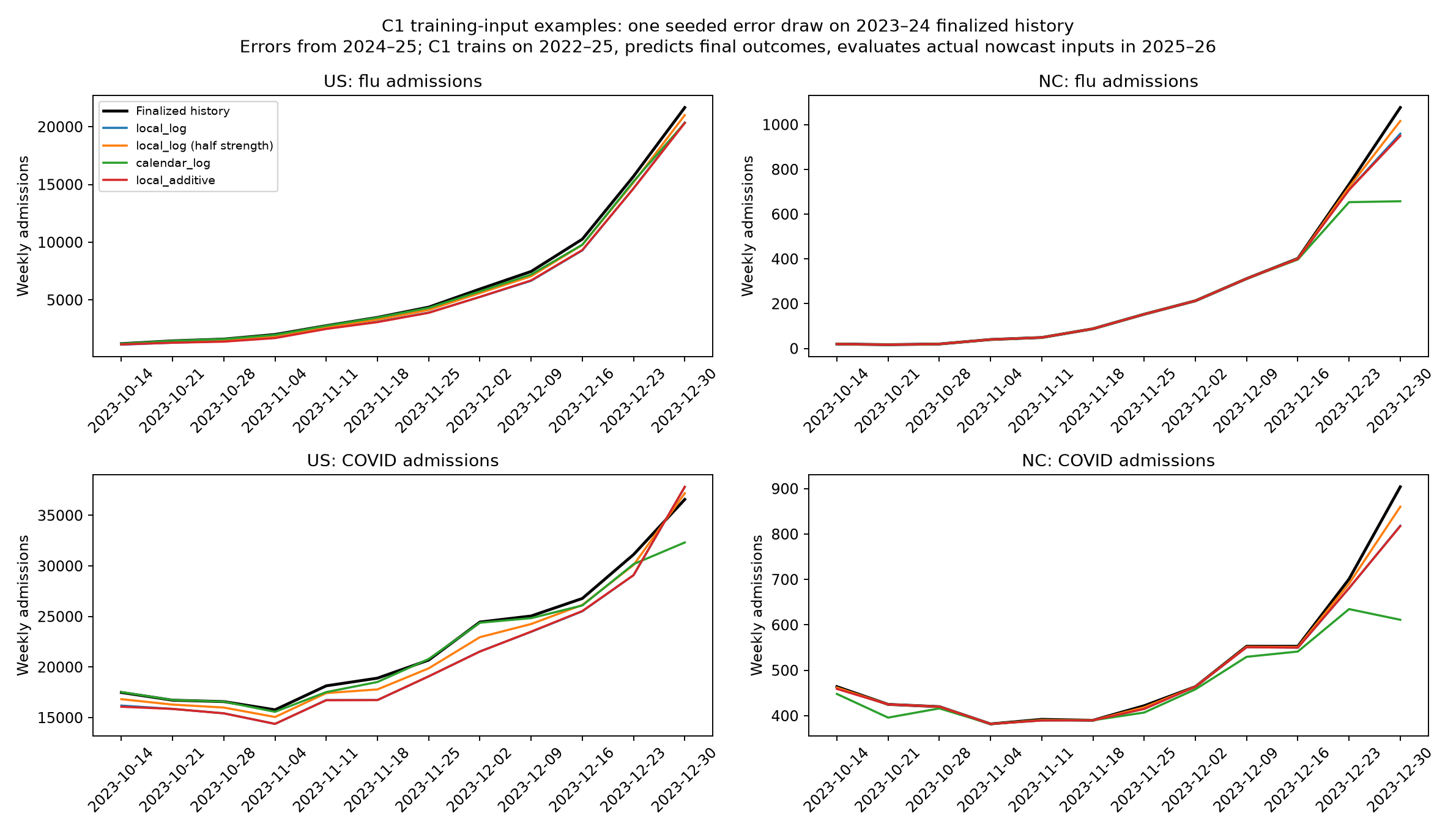
Input audit numbers. The graph below shows one seeded draw on 2023–24 historical inputs used to train C1 on 2022–23, 2023–24, and 2024–25, with finalized future labels and eventual evaluation on actual nowcast-corrected 2025–26 reports. This graph is an input example, not a forecast result.
Analysis of the completed batch
All 12 seed runs, containing 24 fold fits/evaluations, completed successfully. The two GPU allocations took about 51 minutes; the dependent comparison report also completed. The target/season/location/horizon support was checked by the report, and the subsequent analysis verified matching target/seed/geography sample counts against finalized-training C1. Recomputing its weighted target scores reproduced the baseline composite scores.
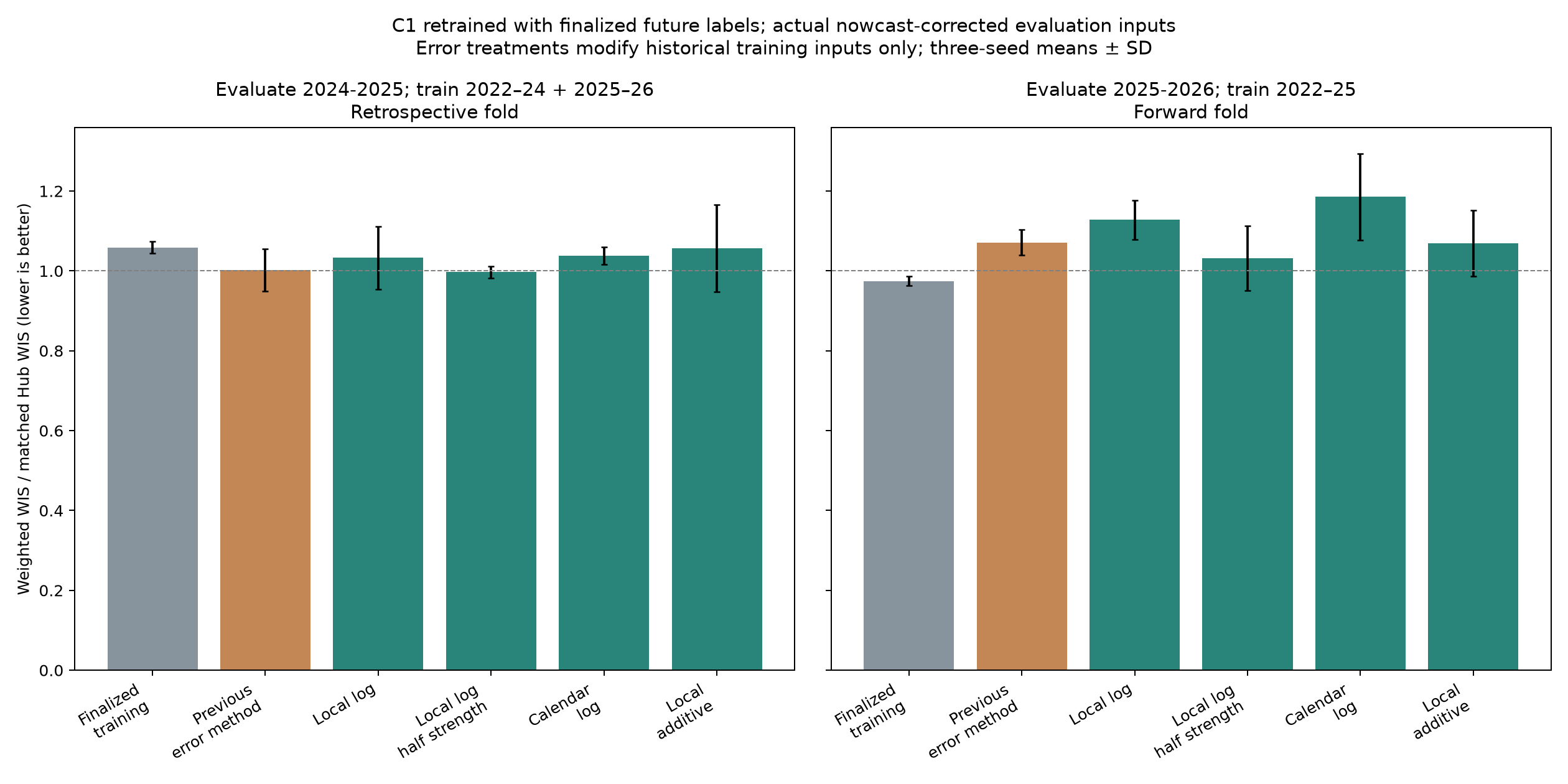
Changing error application matters, but none of these four treatments beats finalized-training C1 on average in the forward 2025–26 evaluation. Half-strength local log errors are the closest alternative. They nearly tie finalized training on the two-season mean because a retrospective improvement offsets a forward loss. That is not evidence of a reliable forward improvement.
Every result below uses C1, finalized future prediction labels, and actual Wednesday inputs corrected by the same causal adaptive-chain nowcaster for evaluation. The training-input intervention alone is listed in the first column; its corresponding early-stopping inputs receive a fixed simulated draw as well. For evaluation in 2024–25, C1 was trained on 2022–23, 2023–24, and 2025–26, with errors learned from 2025–26. For evaluation in 2025–26, C1 was trained on 2022–23, 2023–24, and 2024–25, with errors learned from 2024–25. All values average seeds 42, 43, and 44. Lower relative WIS is better; one equals the matched Hub ensemble.
| C1 historical training inputs | 2024–25 retrospective relative WIS | 2025–26 forward relative WIS | Equal-season mean |
|---|---|---|---|
| Finalized numbers, no reporting-error augmentation | 1.0589 | 0.9747 | 1.0168 |
| Previous national-phase numerical nowcast-error simulation | 1.0017 | 1.0714 | 1.0365 |
| Local seasonal log errors | 1.0325 | 1.1276 | 1.0801 |
| Local seasonal log errors, half strength | 0.9970 | 1.0320 | 1.0145 |
| Calendar-matched log errors | 1.0386 | 1.1857 | 1.1122 |
| Local seasonal additive errors | 1.0565 | 1.0685 | 1.0625 |
Seed consistency and what the combined score hides
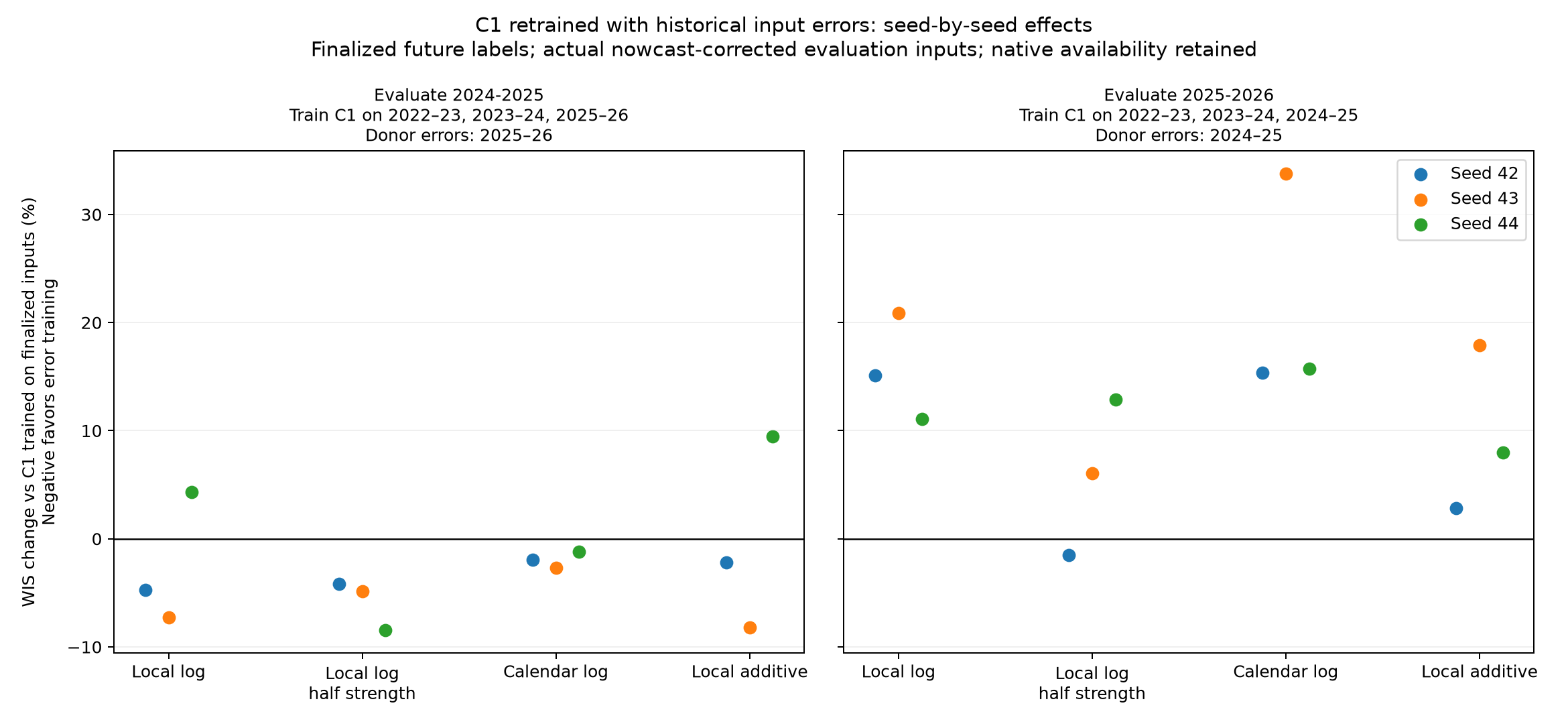
C1 trained with half-strength local log errors and evaluated in 2024–25 improves on finalized-training C1 by 5.8% in mean paired seed ratios, with improvement in all three seeds. The same training method, trained on the older history and evaluated in 2025–26, loses by 5.8% on average: seed 42 improves 1.5%, seed 43 loses 6.1%, and seed 44 loses 12.9%.
The half-strength two-season mean improves just 0.24% in paired seed ratios, with only one of three seeds improving. The paired changes are −2.9%, +0.4%, and +1.8%; their standard deviation is 2.4 percentage points. These are training seed differences, not an independent-season confidence interval. The 2024–25 fold also scores only flu/COVID admissions, whereas 2025–26 scores all six targets. Equal season weighting does not give the two folds identical target support or make retrospective training prospective.
Compared with the previous numerical-error-only nowcast simulation, the half-strength method improves the forward mean paired score by 3.5%, with two of three seeds improving. It therefore partly recovers the earlier degradation, but it does not beat finalized training. Full-strength local log, calendar log, and local additive errors lose to finalized training in every forward seed. Their mean paired losses are 15.7%, 21.6%, and 9.6%, respectively.
COVID explains most of the forward loss
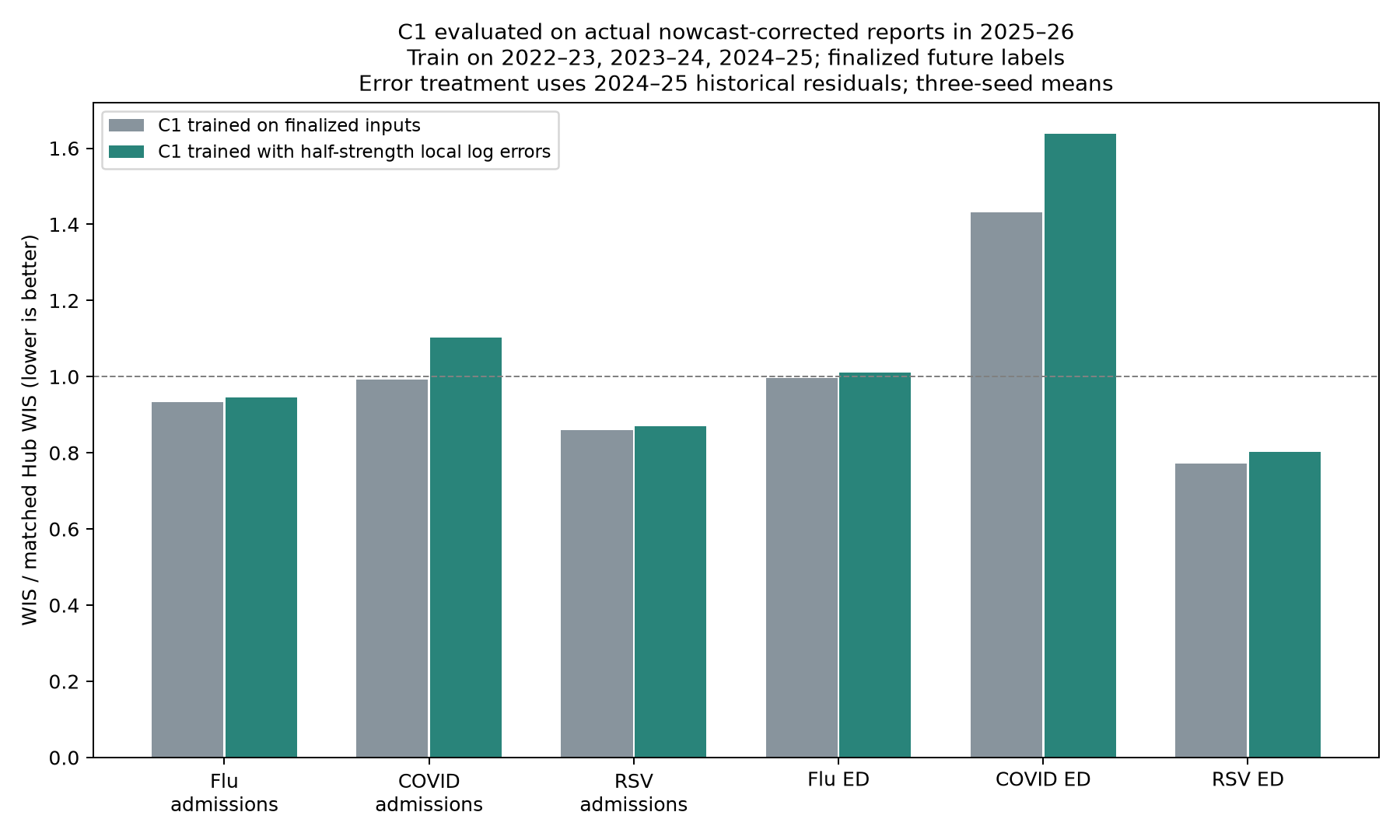
For C1 trained on 2022–23, 2023–24, and 2024–25 with half-strength 2024–25 nowcast errors and evaluated on actual nowcast-corrected 2025–26 reports, all six target mean WIS ratios are worse than for C1 trained on the same finalized history without reporting-error augmentation. Both learn finalized future labels.
| Forward target | Finalized-training C1 | Half-strength error-training C1 |
|---|---|---|
| Flu admissions | 0.9334 | 0.9454 |
| COVID admissions | 0.9934 | 1.1030 |
| RSV admissions | 0.8597 | 0.8699 |
| Flu ED proportion | 0.9958 | 1.0105 |
| COVID ED proportion | 1.4326 | 1.6384 |
| RSV ED proportion | 0.7711 | 0.8022 |
COVID admissions account for 42.5% of the increase in the weighted composite, and COVID ED for 39.9%: 82.5% together. This is a decomposition of the observed mean score difference using the stated target weights, not a causal explanation. It uses the difference of mean scores, rather than the mean paired percentage ratios used above.
The normalized COVID-admission overprediction penalty increases from 0.426 to 0.581; COVID ED's increases from 0.912 to 1.079. Underprediction penalties decline. Nominal 90% COVID ED coverage stays near 52.9% in both conditions; COVID-admission coverage falls from 74.6% to 72.5%. Thus the method does not fix the existing COVID calibration problem. It increases overprediction penalties despite reducing underprediction penalties. Flu/RSV score differences are smaller. In the retrospective 2024–25 fold, half-strength augmentation instead reduces underprediction penalties and improves both admission targets' scores and coverage.
The forward loss is present in both geographic summaries: half-strength error training loses 3.7% versus finalized training for states/DC and 14.6% for the native US forecast, in mean paired seed ratios. The result is not solely an artifact of one geographic weighting choice, though national performance makes the overall loss larger.
Target scores and calibration · Decomposition of the forward loss.
Interpretation and next decision
Keep finalized-training C1 for the current forward forecasting setup. The narrow conclusion is that these four ways of applying historical nowcast errors have not produced a reproducible forward improvement. Do not interpret this as proof that nowcast-error augmentation is inherently ineffective or that a coding bug caused the original loss.
The batch shows sensitivity to perturbation strength and does not establish that log transport or local matching is superior. Half-strength log errors perform better on average than full-strength log errors, but the stronger local log method performs worse than the new local additive method in the forward fold. The batch also changes cross-location donor dependence relative to the earlier method, so comparisons against that earlier method do not isolate matching alone.
Remaining material assumptions are the transfer of normalized errors between seasons, fixed matching bandwidths, and independent donor choices across locations. Residual extraction still masks outer/inner excluded reference dates from the nowcaster's reporting archive. That may alter the errors the nowcaster would make with an intact causal archive; this batch did not isolate that issue. Correct units, signs, mask preservation, and date exclusion do not by themselves validate the simulated error distribution.
Before another parameter sweep, the most informative audit would compare COVID residual magnitude, sign, and cross-state dependence by reporting age and season, including the effect of masking the nowcaster's calibration archive. That is a proposed next diagnostic, not an analysis already performed or a new job launched. No new fitting or scoring jobs were launched for this completed-run analysis.
Results
| Training-input error treatment | Evaluation season | C1 relative WIS | Finalized-training C1 | Previous error-training C1 | Change vs finalized training |
|---|---|---|---|---|---|
| Calendar log | 2024-2025 | 1.0386 | 1.0589 | 1.0017 | -1.9% |
| Calendar log | 2025-2026 | 1.1857 | 0.9747 | 1.0714 | +21.6% |
| Calendar log | combined | 1.1122 | 1.0168 | 1.0365 | +9.4% |
| Local seasonal additive | 2024-2025 | 1.0565 | 1.0589 | 1.0017 | -0.3% |
| Local seasonal additive | 2025-2026 | 1.0685 | 0.9747 | 1.0714 | +9.6% |
| Local seasonal additive | combined | 1.0625 | 1.0168 | 1.0365 | +4.5% |
| Local seasonal log | 2024-2025 | 1.0325 | 1.0589 | 1.0017 | -2.5% |
| Local seasonal log | 2025-2026 | 1.1276 | 0.9747 | 1.0714 | +15.7% |
| Local seasonal log | combined | 1.0801 | 1.0168 | 1.0365 | +6.2% |
| Local seasonal log, half strength | 2024-2025 | 0.9970 | 1.0589 | 1.0017 | -5.8% |
| Local seasonal log, half strength | 2025-2026 | 1.0320 | 0.9747 | 1.0714 | +5.8% |
| Local seasonal log, half strength | combined | 1.0145 | 1.0168 | 1.0365 | -0.2% |
Lower WIS is better; 1 equals the matched Hub ensemble. Changes average paired seed ratios. All rows use C1 and finalized future prediction labels. For evaluation in 2024–25, train on 2022–23, 2023–24, and 2025–26; for evaluation in 2025–26, train on 2022–23, 2023–24, and 2024–25. Evaluation inputs are actual nowcast-corrected reports.
Paired seeds · Summary · Target scores.
October 2, 2026, completed-run analysis: half-strength local log errors partly recover the previous forward loss, but do not beat finalized-training C1 on average. Retain finalized training; distinguish this tested-method result from a universal rejection of augmentation.